When I was working with an organisation building a new policy framework for how it enters into formal arrangements with partners and funders, the money turned out to be the smallest part of the picture.
These arrangements are meant to be mutually beneficial. The organisation gets something it needs, and so does the other party.
Once you put a framework around it, everything the contract does not capture begins to surface. History that may not be formally documented and relationships already in play that will affect how the organisation is seen.
The moment you enter a formal arrangement with someone, your name is linked with theirs, regardless of the fine print. People read who you choose to stand alongside as a statement about what you are and even who you trust.
In this instance, the board started high up. They looked at the principles that should guide these decisions before they looked at any single case.
They took a couple of live examples, stripped the identifying information as much as possible, and tested the principles against them. For a while, it worked, and the thinking stayed at the level of framework and principles.
Then they added detail, and the more detail that went in, the more people started to recognise the stakeholder. Once the name was obvious, the feelings linked to that name arrived. Old history, instinctive likes and dislikes, positions formed long before this conversation.
Maintaining the quality of the thinking became more challenging as the variables grew.
To their credit, they saw it happening. They paused, because nothing useful was going to be decided without that pause. People needed time, away from each other, to think it through. They set a firm date, so the pause could not turn into avoidance.
And they held one line. Whatever they decided had to be transparent and defensible for the next case like it.
These decisions are hard because at the point where the thinking stalls, and feeling takes over, a capable group can make a call with unexpected repercussions. I see it with boards and executive teams, and the mechanics are almost always the same.
When one history colours the whole call
What looks like one decision is three or four, bundled into one, with a feeling about a stakeholder holding them together. There’s a commercial question, a separate question about fit with mission, and a question about reputation.
Each has its own answer. And feelings driven by values and experiences spread across all of them. The decision takes on the colour of that history.
The history is relevant to reputation and trust. The trouble arises when you let it drive answers to the other questions, the ones it has no bearing on.
Decide on the signs, not the name
It’s useful to think of this like when a nurse triages a patient. They assess the signs for one patient the same way they would with everyone who comes through the door. But when the patient is someone they know, it’s harder to separate the assessment from the attachment they have to that person. It is why the way you assess should be separated from whose name is on the chart.
A leadership team can borrow from that. Decide the principle before the name is on the table. Ask what you would do for anyone in this position, against the tests you have already set, and only then bring who the stakeholder is back into the picture.
If the answer changes once you know who it is, don’t ignore the feeling. However, you must decide, in the open, whether it belongs.
It helps, too, to separate what has been bundled and avoid letting three separate questions ride on one motion.
Split them, so each is decided and recorded on its own. Take the commercial question, the mission question and the reputation question apart, and give each its own answer and its own reason on the record. Those reasons are what let you treat the next stakeholder the same way.
There is one more step, and it is the one most often skipped.
Once each question has its own answer, work through what each option opens and what it closes, including the precedent it sets and how it will be read from outside. You are rarely choosing the option with no cost. You are choosing the cost you can live with if the call turns out wrong, and that you could defend if it were made public.
There is good research behind this. Daniel Kahneman, Dan Lovallo and Olivier Sibony spent years studying how organisations make their biggest decisions, and they describe a trap that has nothing to do with how capable the people are.
We form a picture of a situation fast. Faster than the evidence warrants, and on less of it than we would care to admit. Once the picture forms, it sticks. We start reading the facts that fit it, we set aside the ones that complicate it, and we let one strong impression stand in for the whole case.
That first read carries far more weight than it has earned, and it is hard to shift once it has taken hold.
Their answer is not to trust judgement less. It is to change the order. Work out the factors that should drive the decision before you turn to the case. Assess each one on its own evidence, without letting it colour the others. Hold the overall judgement back until every separate assessment is in. As Kahneman put it,
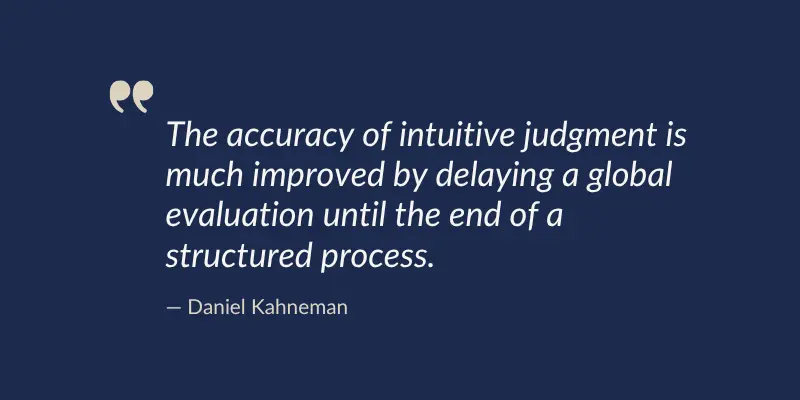
“The accuracy of intuitive judgment is much improved by delaying a global evaluation until the end of a structured process.”
— Daniel Kahneman
For a leadership team, that means naming the questions before the name takes over, and being clear what evidence belongs to each. The call about the stakeholder comes last, not first.
The sequence does one thing above all. It stops one vivid history, one difficult relationship or one trusted name from setting the answer to everything.
It does not take the judgement out of the conversation. It gives the judgement something solid to work with.
Narrowing from the inside
There is a larger pattern underneath this. Many leaders are used to watching their options narrow from the outside, as funding tightens, conditions shift and the space to move gets smaller. That external pressure is easy to see. The narrowing that happens from the inside, one feeling-driven call at a time, is the one that goes unnamed.
The teams that handle this well still have plenty of feeling at the table. What they do is decide where it belongs and keep it there, so the call holds up when the next stakeholder, and the last one, are watching.
Pressures are easier to handle when you read them early, while there is still room to move.
The Convergence Trap is a short field guide I wrote for boards and executive teams in NGO health, community and human services about the external structural pressures building across the sectors, how they interact, and the conversations to start before options shrink.
You can download it here and use it to open that conversation at your next board or executive meeting.