

I have been working with a senior leader with deep technical expertise. The kind of person you want when the detail has to hold up.
They wanted to move beyond operational expertise and influence how a major transition would unfold inside a complex system.
Then an assessment named initiative as a weakness.
On paper, that looked like a problem. Senior leaders stepping into broader influence need initiative. They need to move before every instruction is clear.
But the rest of the evidence did not fit. Personal responsibility was strong. Persistence was strong. Relationship management was strong. Social adaptability was strong. When action was needed, they could act.
The issue was not initiative. They were overwhelmed with too much information. Too many possible moves. No clear way to read the conditions and choose the next step.
I am sharing this because I see the same pattern in senior teams across NGO health and community services.
Strong operators are being asked to step beyond delivery and contribute to the organisation’s next moves. But when pressures begin to interact, many default to what they know best: their own patch, and what worked before.
That leaves the CEO carrying too much. And for the senior leader, it can feel deeply frustrating. They know they are capable and trusted with the detail, but less certain when the pieces start moving.
The dashboard and the road ahead
Good operators watch the dashboard. Speed, fuel, temperature, the condition of their own vehicle.
The most effective senior leaders also read the road ahead. Where it bends, where the lanes narrow, where the weather has changed since they last looked up.
The dashboard tells you about now.
The road tells you what is coming.
Most leadership development still trains people to manage the dashboard. But senior leaders now need to read the road while it is changing.
DDI’s recent leadership research points to the same gap. Its assessment data from more than 100,000 leaders found that just 8 per cent of executives demonstrate strong change leadership despite their positional authority. Separately, DDI’s Global Leadership Forecast found that the percentage of leaders who feel prepared to manage change has declined by nearly half over the past five years, from 25 per cent to 13 per cent.
It is a widening gap. And it is most pronounced at the senior level, where the pressure is highest and the conditions are shifting fastest.
Sitting in an inflection point
Many NGOs in health and community services are sitting in inflection points now. Funding models are under pressure, workforce costs are rising, demand keeps climbing, and regulatory expectations are growing all at once. Each brings its own pressures, but combined, their future impact cannot be ignored.
Andy Grove, a former CEO of Intel who led the shift from memory chips into microprocessors, described this kind of moment in Only the Paranoid Survive:
A strategic inflection point is a time in the life of a business when its fundamentals are about to change. That change can mean an opportunity to rise to new heights. But it may just as likely signal the beginning of the end.
– Andy Grove
When the next move is not obvious, CEOs need senior leaders who can do more than report what is happening. They need people who can read the conditions, frame the options, and move before choices shrink.
Yet this is where CEOs often feel the drag. Their senior leaders are capable, but too many issues still arrive as operational updates rather than strategic choices. The CEO is left carrying the interpretation. What matters, what connects, what could happen next, and which option keeps the organisation moving.
A filter for when the options look overwhelming
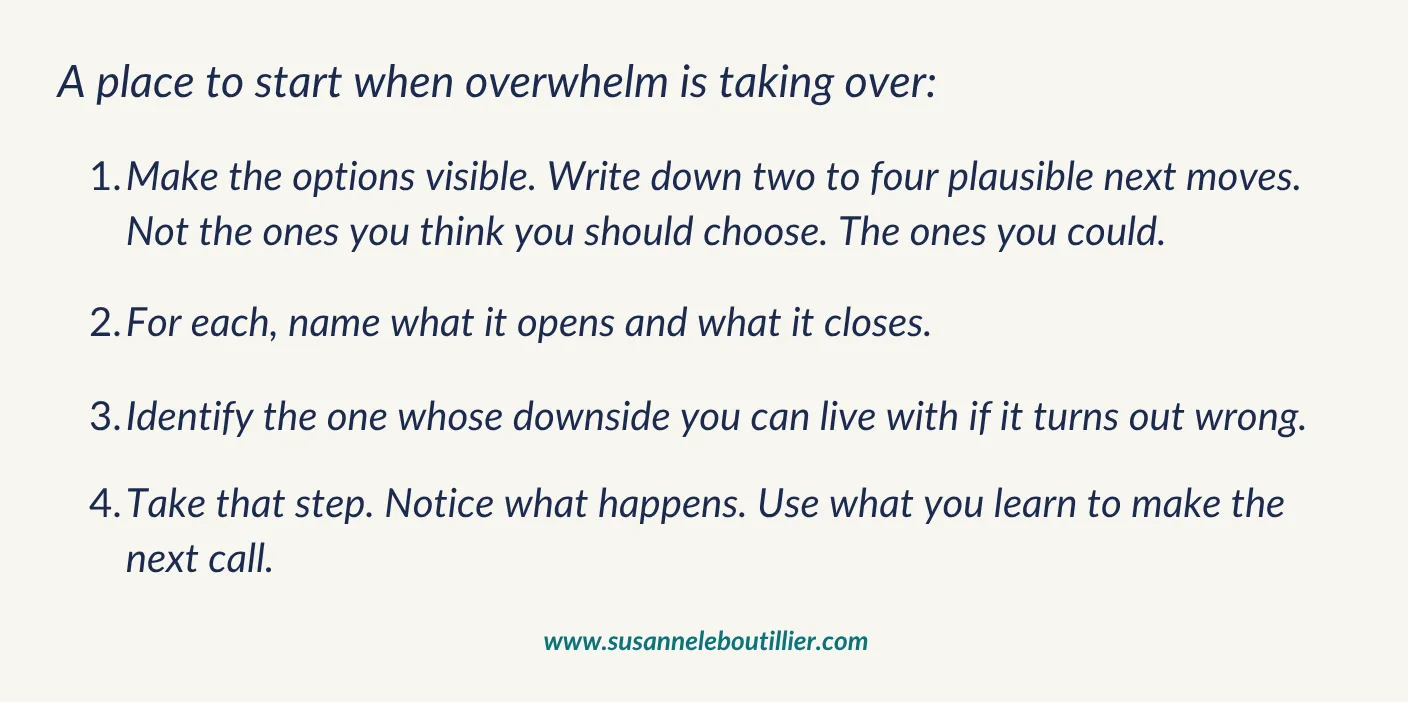
This is a place to start. The leader I have been working with is using a version of it now. It has not made the territory simpler. It has made taking the next step possible.
If this is the layer you are building
Lead Through Convergence launches in Brisbane on 30 July. It is a 90-day program for senior leaders in NGO health and community services who are stepping beyond operations and need a method for reading shifting conditions, testing their own assumptions, and bringing sharper judgement to live organisational issues.
By the end, participants have a working method they can keep using when a new signal lands, when direction shifts, or when their own thinking starts to narrow. CEO sponsors provide observer input before and after, so the shift is visible, not just hoped for.
If you are a CEO and you can already name the senior leader this is for, the details are on the program page. If you are that senior leader, and you know the next version of your contribution depends on reading wider, framing better, and catching your own patterns sooner, you can also apply directly.
Or reach out and I will let you know whether the program would be a good fit.
Lead Through Convergence