
An expired leadership script does not feel broken. That is what makes it dangerous.
When a board, funder, regulator or executive team stops responding the way they used to, many leaders are still relying on the moves that once made them effective. The moves are fluent. They are familiar. They used to work. And yet the response coming back has shifted.
At a recent Peer Room breakfast I facilitate for chief executives of NGOs in health, community and human services, the question on the table was how to read and work with the rhythms of government when those rhythms keep shifting. Much of the conversation came back to the same problem. The approach these leaders had used with government for years had stopped working. The script written for the last government does not fit this one.
That is not only about government engagement. Every senior leader runs their own scripts.
The script that stops updating itself
A script is the set of moves that have worked for you. How you take a recommendation to your board. How you frame a funding case. How you bring your executive team with you on a hard call. How you handle a regulator or a difficult stakeholder. You built each of these because it worked. Over time it stops being a choice you make and becomes the way you do it.
That is the point of a script. It is efficient. It saves you from thinking through every interaction from scratch. A senior leader with no scripts at all would never get through the week.
The trouble is that a script is built for a particular set of conditions. When the conditions move, the script does not know. It keeps running. And it keeps feeling like competence, because it is fluent and familiar and it used to work.
The problem is relying on how a script feels. An expired script can still feel like competence. Focus instead on the response you get as you follow the script. The board coming back with more questions than usual. A stakeholder telling you that what they thought was a partnership now feels like a transaction. A team that acknowledges the script and then ignores it.
When a script stops landing, the instinct is to run it harder: more briefings, more meetings, the same case made again with more force. Donald Sull called this active inertia, the habit of responding to new conditions with old patterns. Action alone does not solve the problem if the action is still being shaped by old frames, relationships, processes and values. As Sull puts it:
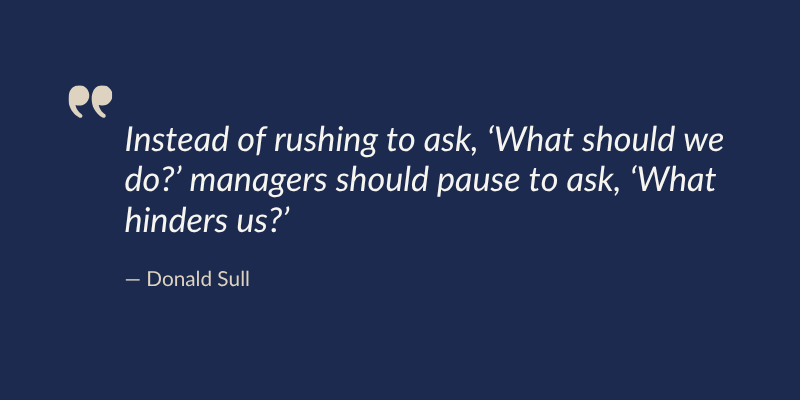
Instead of rushing to ask, ‘What should we do?’ managers should pause to ask, ‘What hinders us?’
– Donald Sull
An expired script does not announce itself. It hides inside your competence, which is the one place you are least likely to look.
Reading the response, not the script
The gap is what you look for. Find the place where you are making a familiar move and getting an unfamiliar result. That gap, between the response you expected and the response you got, is a good indicator of whether the script still fits the conditions.
The instinct will be to explain the gap away. The board is risk-averse this year. The funder is distracted. The team is stretched. Sometimes that is true. The instinct to explain it away is also the script protecting itself. Notice how fast that instinct arrives.
What an expired script needs
Finding the gap tells you the script has expired. It does not tell you what the new one is.
The instinct is to adjust the old script. Make the same case more carefully. Put a bit more weight behind the same approach. An expired script does not need a more careful version of itself. It needs a fresh read of the conditions it now has to work in.
That fresh read is hard to reach from your own seat. You cannot rely on your executive team for it either, because they helped build the script. What helps is a seat that is not yours, a peer working the same problem from a different position. You ask them one question:

That question is simple. It is also difficult to answer well unless the room is right. In the Peer Rooms I facilitate with NGO CEOs, this pattern is becoming more visible. Leaders are not short on effort. They are often working harder at approaches built for conditions that have already changed.

Where this fits
This is what shaped The Wider Lens. The first Brisbane session is Thursday 16 July. Applications and nominations are now open at susanneleboutillier.com/the-wider-lens.
It is for senior leaders in health, community and human services who are working complex decisions, reading shifting external conditions, and would benefit from testing what they are seeing with credible peers outside their own organisation.
If you lead senior people who would benefit from that wider read, nominate them. If that person is you, apply directly. Places are curated so the mix of roles, sectors and perspectives is right.
Outside Brisbane? Let me know where you’re based and register your interest for a virtual session. I’ll be in touch as soon as we open online cohorts.