
I reorganised the pantry earlier this year.
Everything came out onto the bench. I wiped down the shelves, sorted through what was still good and what was well past its use-by date, then put what was left back in an order that made me feel very organised.
Three weeks later it was back to being less than organised. The system I had set up made sense in theory and this time I couldn’t put the blame on someone else not following it. It fell apart because when I was busy or in a rush I’d shove things back in, wherever there was a space and didn’t pay attention to how I’d intended the system to work.
The reorganising was the satisfying part. Keeping the system going would have meant slowing down every time I was in a rush, and I wasn’t willing to do that.
Leaders do the same thing with reflection. I think of this as the reflection–behaviour gap: the distance between what a leader can see and what they are prepared to change.
Noticing, and not changing
Many senior leaders reflect a great deal. On the drive home, or during a morning walk. What they notice is usually accurate and can be uncomfortable. It might be a realisation that too many of the decisions are being made by you, or that you are letting the team reach the answers too fast.
Then you get to next week and do all of it exactly as before.
The reflection is genuine, and perceptive. It feels like you’re doing something to develop, and that’s the problem. Once you have named what showed up, you feel like you’ve dealt with it.
Noticing something about yourself and changing what you do are two separate capabilities. Time spent thinking about your leadership can feel like leadership development. You bring the same observation to your coach in March and again in September, a little more articulately each time, and the improvement in how you can articulate it passes as progress.
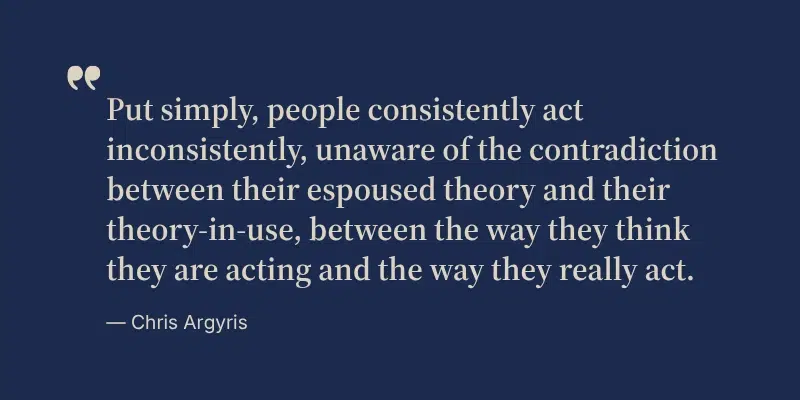
Chris Argyris, a professor at Harvard Business School, spent much of his career studying why highly capable professionals struggle to learn from their own behaviour. He put it this way:
“Put simply, people consistently act inconsistently, unaware of the contradiction between their espoused theory and their theory-in-use, between the way they think they are acting and the way they really act.”
— Chris Argyris
The gap I found in the early data
When I piloted the Centred Leadership Diagnostic with 34 senior leaders in complex roles, two adjacent statements produced a striking gap.
“I regularly reflect on my leadership approach” averaged 4.2 out of 5.
“I adapt my behaviour based on what I notice about myself and my impact” averaged 3.3.
The average gap within individual responses was 0.89 points.
This is early pilot data, not peer-reviewed research. Even so, the pattern was consistent across the individual responses.
Argyris argued that people are often unaware of the contradiction between how they believe they act and how they actually act. The leaders in this pilot appeared to recognise a related gap: they rated themselves substantially lower on adapting their behaviour than on reflecting on it. Awareness may be a first step, but it was not enough to close the gap.
What you are protecting
The behaviour persists because it is protecting something.
Often, in my work, that something is a standard. A leader takes the paper back because they do not trust that it will be completed as well by someone else. The commitment to quality is genuine.
But the paper is only one result.
The other result is the person who never becomes better at writing it.
You protect quality in the short term and manufacture dependency in the long term. Then, a year later, the team’s lack of capability looks like proof that you were right to hold on.
Across an organisation it shows up as decisions banking up with one person, while the people who should be taking them have not had the practice.
Nothing moves until you name what you are protecting and make a decision about which of the two you are choosing.
A way to check
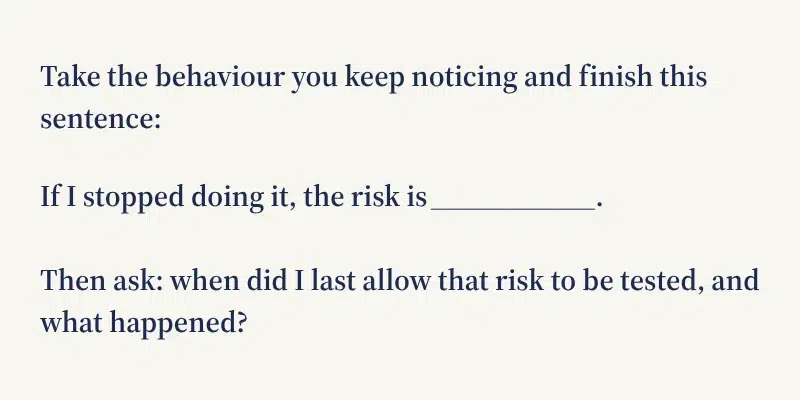
You may discover that the risk is smaller than it feels. You may also discover that you have never tested it, because the behaviour protecting you from the risk prevents the test from happening.
Until the feared risk sits beside the real evidence, there is no decision. There is only an intention that is never actioned.
If there is something your team keeps naming and never changing, reach out and tell me what it is.
Written with AI assistance. The thinking and the final wording are mine.