

Turning pushback into personal motivation
From what’s publicly reported, Kate Quirk appears to have ignored the accepted rulebook early in her career.
In her first role as Chief Health Information Manager at Caulfield Hospital, she was seen by many as too young and too fresh from university for the role. But she leaned in. She ignored the detractors, engaged with the system, and used the pushback she got as fuel.
Soon after, she stepped out of her comfort zone and moved interstate for a role, crossing into male-dominated sectors. She started leading the accounts others avoided. She didn’t take safe steps; she took steps that tested her growth edge.
By 2018, she was leading MKM Health. When Alcidion acquired MKM, she was asked to become CEO of the combined business — and in doing so, became the only female CEO among the 46 ASX companies on Australia’s All Tech Index.
Publicly, Kate has spoken about empathy and values as anchors for how she leads — leading by example and being prepared to muck in when needed, and staying true to a set of values, no matter what happens. I suspect that’s only part of the story. There was likely a lot more going on beneath the surface.
What’s been consistent throughout her career, is her leadership in complex operating environments, and in those, friction can build fast. It can appear as duplicated efforts, slow decisions, and too many conversations that don’t turn into action.
The Centred Presence Model
We often dismiss that friction, but Bain’s research shows the average organisation loses over 20% of its productive capacity to organisational drag.
That’s why presence can’t be reduced to how you dress or make a single presentation. It’s about how you cut through that drag.
That’s why I use the Centred Presence Model — to look at how leaders work across three domains: self, others, and the system, and most importantly, what happens at the intersections between them.
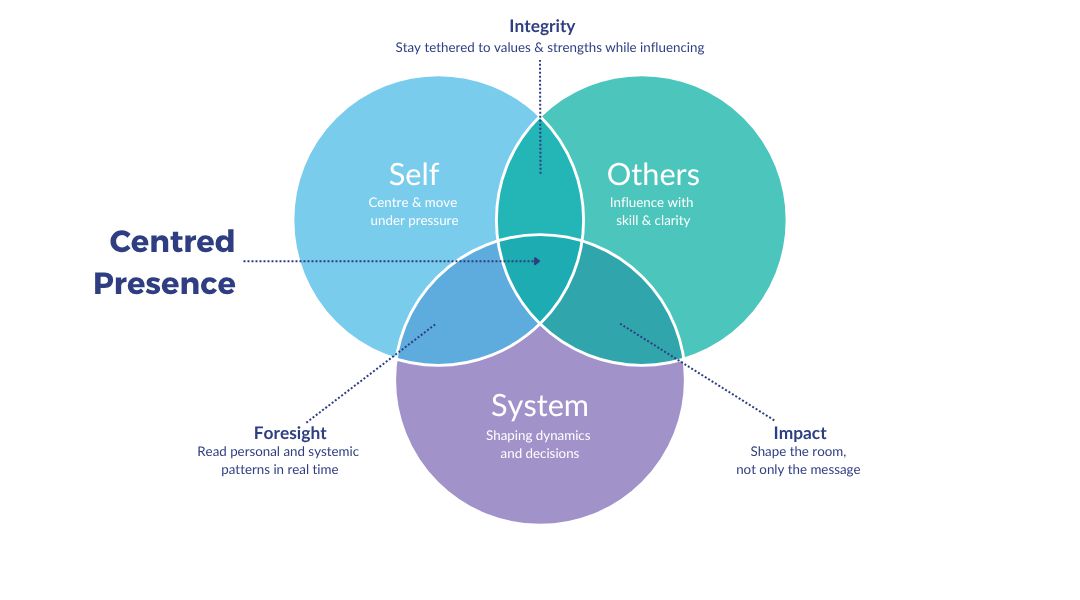
Kate’s story points to what happens when leaders work across those intersections because impact isn’t driven by polish or composure. It’s driven by how you think, how you engage others, and how you shape the conditions around you so that good work can happen and hold.
Presence works a bit like being a sound engineer at a live gig. You’re not the one on stage, but you’re tuning multiple channels at once — adjusting levels, cutting feedback, and creating the conditions where every element can be heard clearly. You can’t control the song, but you can help it sound right.
The first step is to remember we are not operating in isolation. As Donella Meadows, a pioneer of systems thinking and author of Thinking in Systems (2008), said:
“The interconnections in the system that change over time determine the system’s behavior.”
— Donella Meadows
Presence that shapes outcomes
If we want to have presence that influences outcomes, we need to think about how our presence is showing up in that system.
Centred Presence starts with awareness. You can begin by paying attention to:
- What’s moving in you — the patterns, habits, or reactions that show up when things get complex.
- What’s moving between you and others — the tone, energy, and flow of connection.
- What’s moving around you — the wider context, the signals that something is shifting.

A new Centred Presence Diagnostic will be available in the next couple of weeks. It helps leaders identify where they’re strongest and where they might need to focus next — across self, others, and system.
If you’d like early access to the diagnostic when it’s ready, get in touch with me and I’ll make sure you receive the link.