

In a crisis, leaders are often rewarded for speed.
The danger is that speed can shrink the frame and lead to unintended consequences.
On Boxing Day in 2004, the tsunami hit. I was pulled into a problem that looked like payroll. It wasn’t. It was a cross-functional leadership decision involving legal risk, workforce safety, indemnity, and operational authority. Solve it too narrowly, and the second problem becomes bigger than the first.
In a crisis, leaders are often rewarded for speed.
The danger is that speed can shrink the frame and lead to unintended consequences.
On Boxing Day in 2004, the tsunami hit. I was pulled into a problem that looked like payroll. It wasn’t. It was a cross-functional leadership decision involving legal risk, workforce safety, indemnity, and operational authority. Solve it too narrowly, and the second problem becomes bigger than the first.
We needed to send a clinical team into Aceh as part of the emergency response, and we needed to make sure they could be paid on an emergency overseas aid deployment.
There was no mechanism for that.
The clinicians were so committed to helping that they were prepared to go anyway. They were saying they would take leave if they had to. But it was obvious quite quickly that pay was only one part of the job. It reached across functions and carried consequences well beyond getting teams on a plane.
We had the arrangements settled and signed off before the first team landed in Aceh on 29 December.
This pattern of trying to solve a problem too narrowly shows up when conditions outpace the systems meant to manage them. Funding rules shift. Risk settings tighten. A problem lands in one function, but the consequences spread across many.
The key is to keep moving as you widen the frame without letting the fix harden too soon.
Leaders get into trouble when they solve the first visible problem too narrowly and create a second one in the process. You see it when a financial risk mitigation strategy weakens service delivery or a governance safeguard reduces risk but slows delivery when responsiveness matters.
This is a common leadership trap. A 2024 Harvard Business Review article drew on Paul Nutt’s study of 350 decision processes in medium to large organisations, where more than half failed to achieve the intended result, often because time pressure narrowed how the problem was examined.
As Thomas Wedell-Wedellsborg puts it:
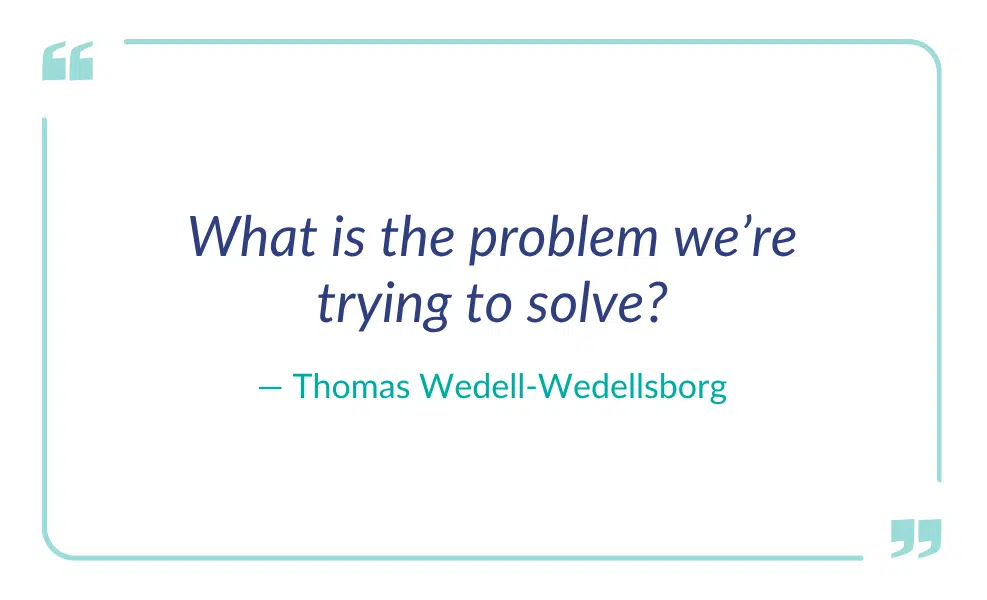
In complex systems, the danger is rarely the first problem you see. It’s the chain reaction that starts when leaders solve the visible issue and miss the system around it. In complex organisations, leaders rarely get punished for the first problem. They get punished for the ripple effects they didn’t see coming.
When pressure rises, the frame usually collapses in predictable ways.
These are the signs I watch for.
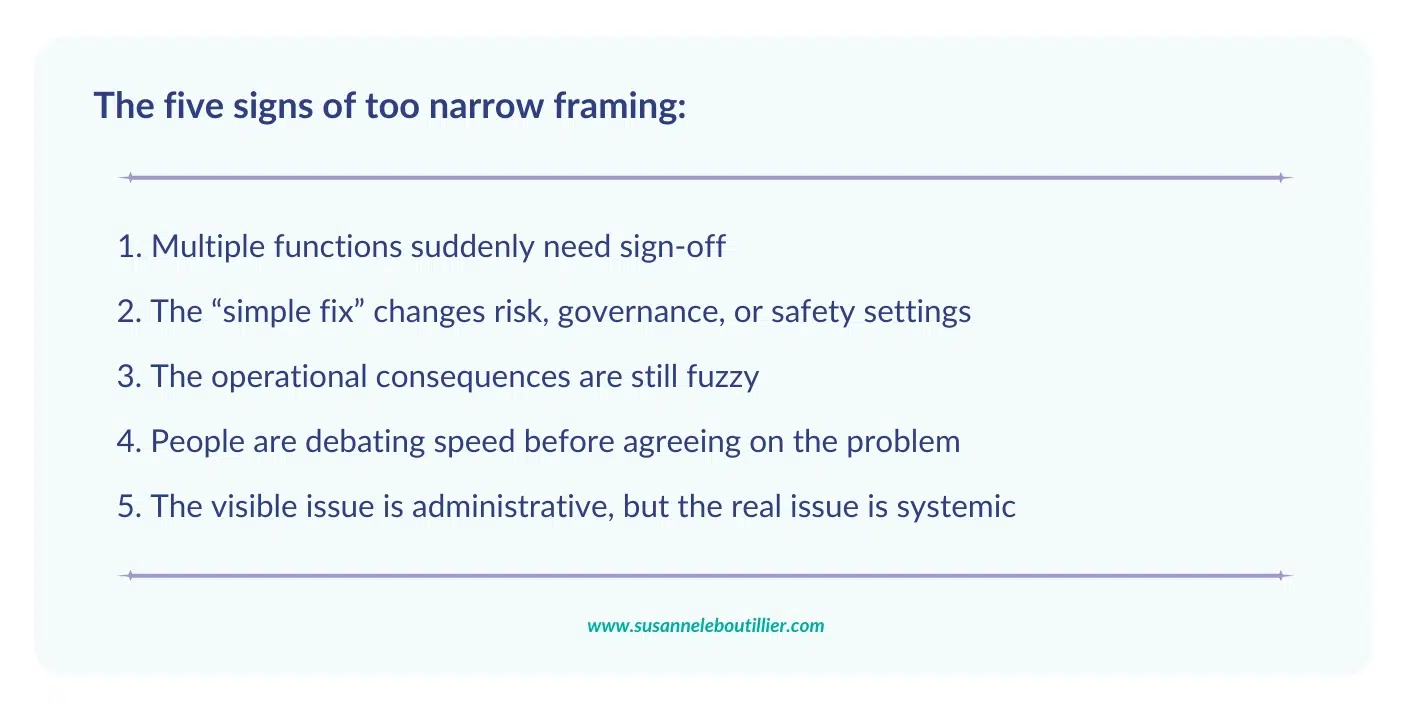
Strategy, governance, and execution start pulling against each other when leaders solve too narrowly.
The question is not just, “How fast can we move?”
It is, “What else moves when we pull this thread?”
When you do this, you avoid unintended consequences that create bigger problems later.
This is the work I help leaders do: recognise when pressure is accelerating the decision while narrowing the judgment. Because when everything shifts, the goal is not just to move fast. It’s to move fast without creating the next problem.