
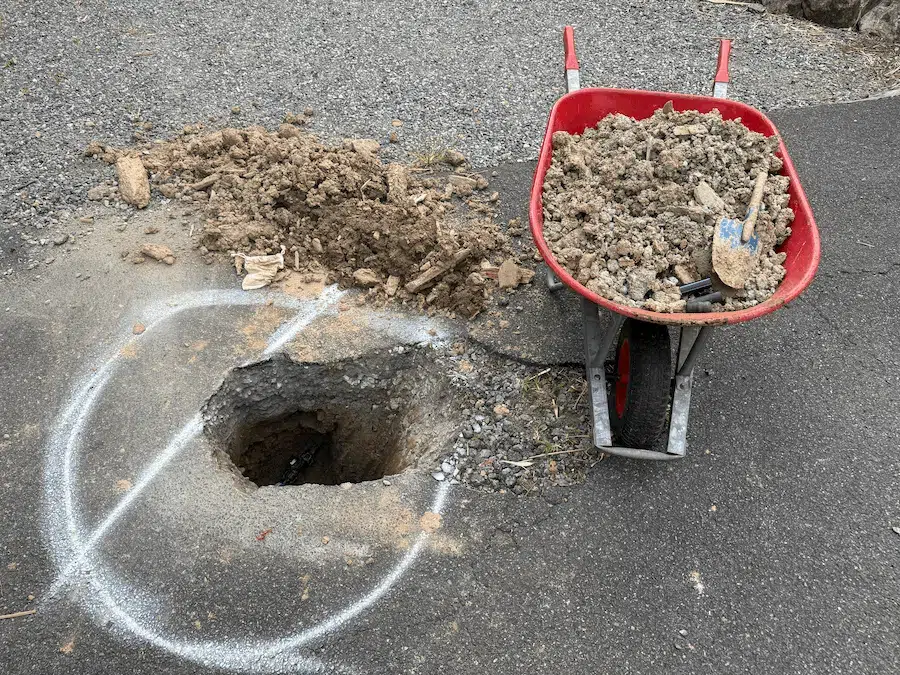
A few years ago, we had a water leak at home. The skyrocketing water bill gave it away.
We called in the leak detection crew. They did the full sweep. Nothing. For hours.
Then they moved their car.
There it was, under the bitumen driveway, right where they’d been parked.
Fast forward, and we still have the pothole where the line was repaired. It was part of the landscape. Until one morning, I thought it looked a bit damp.
The next morning, there’s a thin spread of water across the driveway. The top of my car is wet too, so I’m wondering whether my husband hosed it off to deal with some bird or bat business before work?
When I came back later, that patch was still there.
I rang my husband. He’s local, so he comes home and turns the water off at the mains.
We decide we can limp along for a few days. Water on when we need it. Water off the rest of the time. Contain the damage until he can dig it up and fix it on the weekend.
Except that weekend is a forecast weather event. The event doesn’t arrive, but the rain does. All weekend. Clay soil. A deep hole. Bad combo.
So we wait another week.
The next week, he gets distracted. Fuel pump on the bike. Repainting the front step I’ve been asking about for years. Everything except the thing that’s pushing our water bill north.
So we keep doing the workaround. Up to the far corner of the property. Turn it on. Back. Do what we need. Up again. Turn it off. Repeat. Plan your washing. Time the dishwasher. Don’t forget you need water to brush your teeth.
It’s annoying.
It’s also sometimes the only sensible option you’ve got.
What matters is how you run the interim without letting it become the operating model.
Delay isn’t a character flaw. It’s a risk decision.
When the fix has to wait
In delivery environments, this is normal.
Anita Tucker and Amy Edmondson studied how busy professionals respond to constant operational glitches. They found that capable people default to what keeps the work moving. They identified a rule of thumb: “do what it takes to continue the task … no more, no less.” People did that for 93% of the problems they encountered. The workaround stayed. The underlying issue waited.
The reality is fixes often wait because of dependencies, timing, approvals, weather, resource constraints, politics, sequencing, or the simple fact that you cannot stop the machine for long enough to do the repair.
The total cost of delay increases when the interim becomes normal:
- Cost leakage compounds
- Risks evolve as conditions change
- Workarounds become default practice
- Extra steps consume leadership attention.
If you’re going to live with the workaround, it needs to be treated like a risk decision.
“A bad system will beat a good person every time.”
— W. Edwards Deming (Deming Institute)
So the question is “how do we stop temporary measures turning into unmanaged, indefinite operating conditions?”
If it’s interim, make it visible
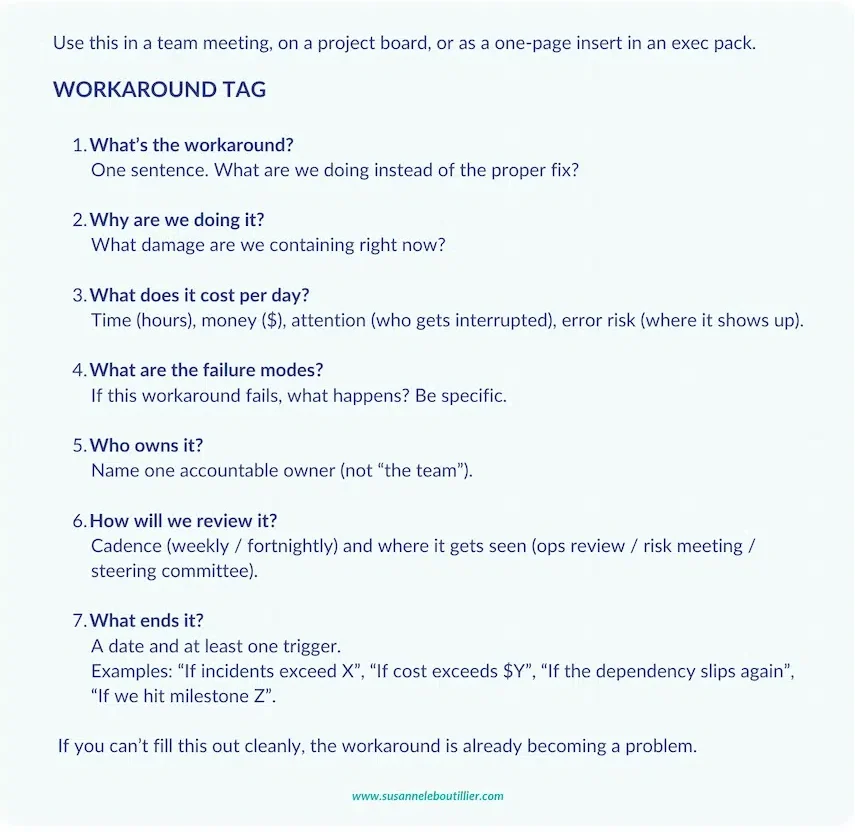
If you’re going to run a workaround, tag it.
Think of bright blue painter’s tape over a dodgy electrical switch: TEMP, date, initials. The tape isn’t the fix. It keeps it visible.
The tape doesn’t fix anything, but it stops the workaround blending into the background.
A tagged workaround makes four things explicit:
- What it’s protecting (cost, safety, service continuity, customer impact)
- What it’s risking (failure modes, loss of quality, compliance exposure, reputational blowback)
- What it’s costing per day (time, money, attention, error likelihood)
- What ends it (review date and escalation triggers)
The Workaround Tag
Three questions worth asking
- What damage are we containing, and what new damage are we introducing with this workaround?
- If we keep this in place for 90 days, what will it normalise in cost, risk, or behaviour?
- What is the trigger that forces a different decision, and who will make that call?

)