

There are lines I keep hearing in conversations with government, health and community service leaders. Each one sounds reasonable on its own. Together, they point to something more serious I call the Convergence Trap.
My brain has been compared to a pinball machine. Since the beginning of 2026 it has been bouncing between statements like these.
“We’re having to save money too.”
“We can’t give what we don’t have.”
“Our service model works well and gets outcomes.”
“We’ve been doing it this way a long time.”
“The wage increases are going to hurt us unless we get full indexation.”
“We’re so busy trying to meet demand we don’t have time to look at how we could do things differently.”
Each one makes sense in the conversation it came from. Put them together with other signals, and they are the convergence trap. Where waiting will narrow your options.
The organisations many health and community services CEOs lead exist to support people experiencing vulnerability, and demand keeps growing. The internal conversations CEOs are having about cutting costs or reducing services are happening at the same time more people need their services.
They are already framing the conversations they will need to have with their teams. About roles. About hours. About programs that may need to be wound back or stopped altogether. Hard choices about what they can keep doing.
They are so focused on those conversations that many are not giving enough attention to the conversations that will decide whether the organisation is still viable in the future.
The funder is also caught
Funders don’t have the money to keep paying for what is currently being delivered, in the way it has previously been delivered.
Yet their procurement and contract management habits haven’t caught up with what the future requires. We’re still seeing a reliance on detailed inputs rather than outputs and outcome markers to measure return on investment. This constrains the very innovation they are seeking.
The rescue that is unlikely to come
Many of these CEOs are hoping a rescue package will arrive. The mid-cycle funding injection. Indexation that covers the cost gap. The kind of bailout that has come before in moments like this. I think the scale of rescue they want is unlikely to come.
Funders cannot pull money out of a budget they do not have. What they can do is release how the service is delivered and put more flexible guardrails in place so that providers have room to redesign their service models.
NGO leaders need to name this tension when they sit down with their funders.
Five signals, not one
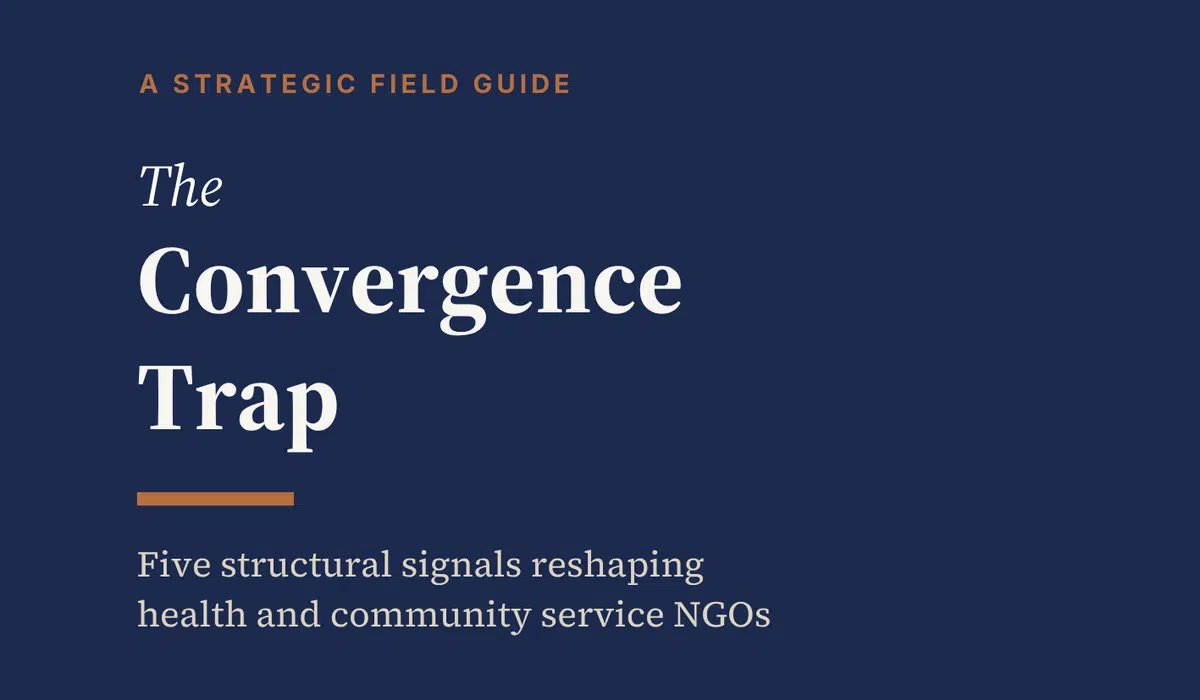
Rising wage costs are one visible signal. The Convergence Trap field guide names five structural signals reshaping the operating environment for NGOs in health and community services:
- the liquidity trap
- the structural cost squeeze
- the commissioning reset
- evaluation as the gatekeeper and
- AI as compliance architecture.
I’ve unpacked these five signals in The Convergence Trap Strategic Field Guide, a complimentary resource for NGO boards and executive teams who need to step back from immediate pressure and see the larger pattern forming.
If three or more are landing on you at once, the conversations they force at the board and executive table are what the field guide is built to support.
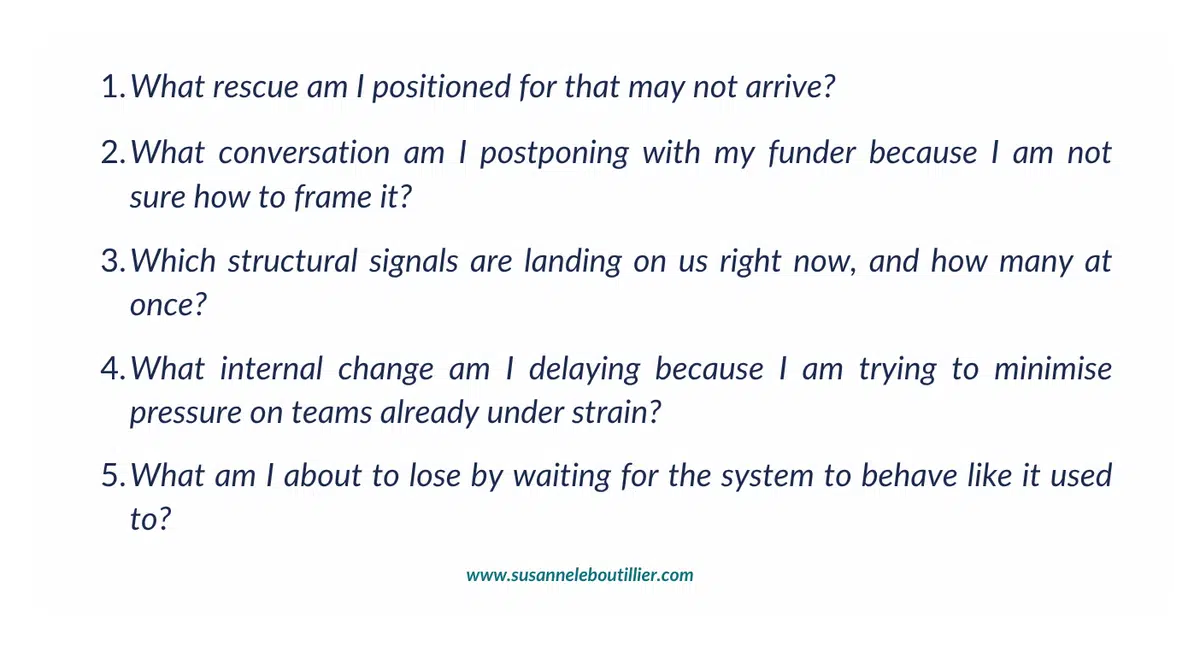
Questions to consider
These are the questions I want to leave you with ahead of your next board paper, or conversation with your funder. These are hard to answer well when you are inside one organisation looking out, and easier when you can hear the same patterns landing in different parts of the sector at once.
A note before signing off
If you sit on or around an NGO board in health and community services, The Convergence Trap Strategic Field Guide will help you step back from the noise and see the structural signals more clearly.
It is a complimentary download designed to support board papers, executive discussions and funder conversations where the real issue is no longer one pressure, but several landing at once.
This is exactly the kind of conversation I help boards and executive teams get into the open.
The lines you have been hearing in your own conversations are pieces of a larger pattern. Reading them together is what gives you back the time to act before the ball drops.