
Most leaders don’t wake up planning to betray their values.
I finally finished watching The Man in the High Castle. It’s a dystopian alternate-history series: part espionage drama, part resistance story, part moral horror story. One where small compromises become the reference point for the next one, until lines people said they would never cross are already behind them.
It’s built around a disturbing question: what would ordinary, capable, ambitious people become inside a system that rewards compromise, obedience, fear, and self-protection?
In the show, John Smith is an American who becomes a high-ranking Nazi officer. His transformation is not a single dramatic conversion. It is a sequence of compromises.
Protect his family. Keep his position. Stay useful. Avoid becoming a target. Do what the system requires.
Values are rarely abandoned in a speech or a dramatic betrayal. They are usually abandoned when we hear ourselves saying “I had no choice” or “I need to get through this.”
The show keeps pressing the harder point: people use pressure to excuse choices that pressure has merely revealed.
Competent but untethered
John retains enough self-awareness to know what he has become but not enough moral courage to stop. He keeps confusing control with judgement. He believes that if he stays powerful enough, he can keep the worst away from the people he loves.
But the price of staying powerful is ongoing participation in the very machinery that destroys families, communities, and human beings.
Five ways judgement fails under pressure
The John Smith story arc is rich because it separates judgement from intelligence, composure, and effectiveness. He has all of those. What he loses is orientation.
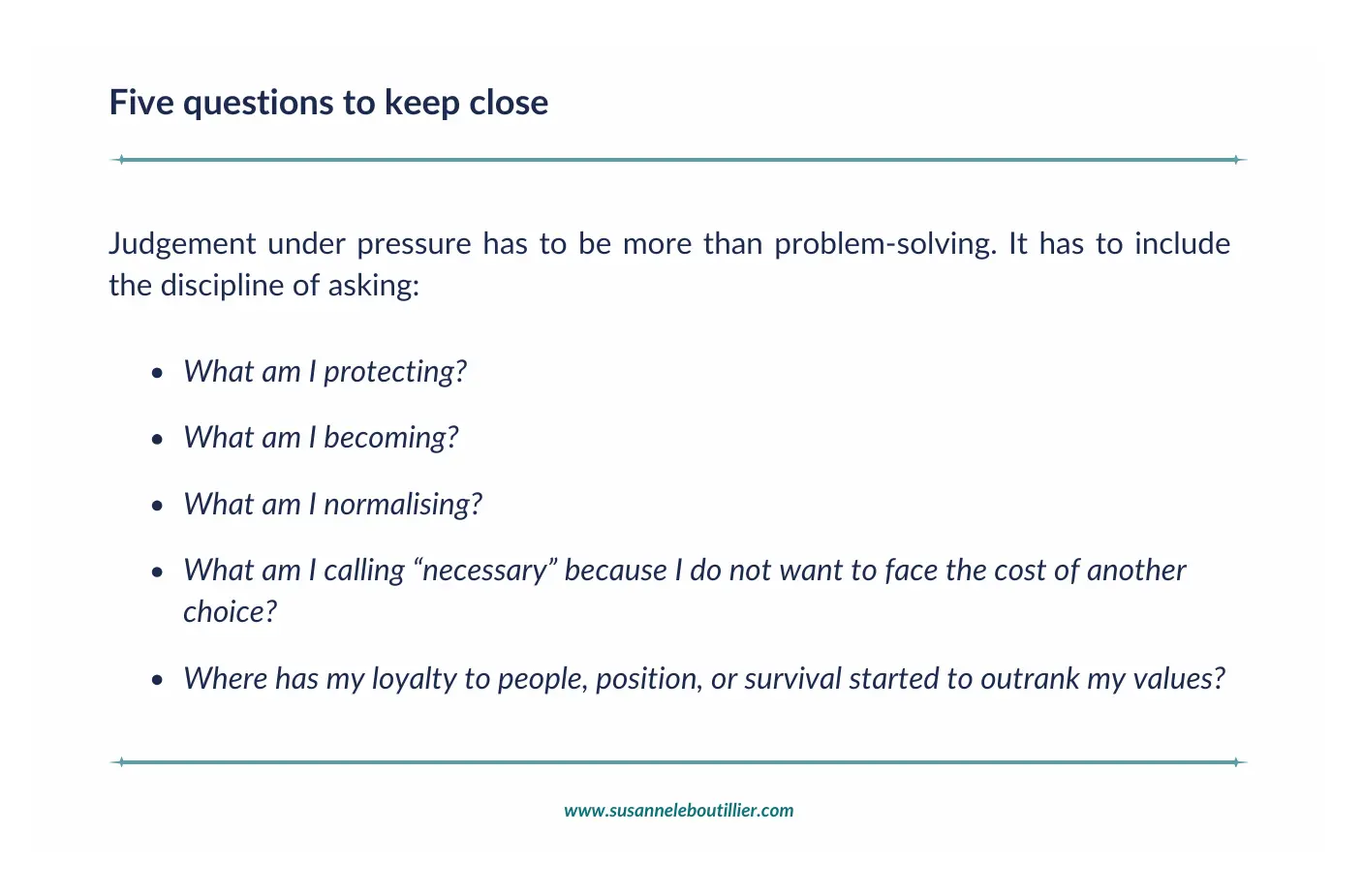
Under pressure, judgement fails when a leader:
- Narrows the frame to immediate survival. Solving the next problem while avoiding the larger question: what am I becoming by solving it this way?
- Lets loyalty become possessive. Telling yourself the choices are for someone else, when increasingly those people become the justification for protecting your own power and identity.
- Treats values as optional under threat. Once values become conditional, the conditions keep expanding.
- Mistakes adaptation for integrity. John adapts brilliantly to the regime. Adaptation without a tether becomes accommodation.
- Confuses being trapped with being absolved. Constraint is real. The show keeps pressing the harder point: constraint does not erase agency.
How this shows up as a leader in reality
Senior leaders aren’t often leading on the same scale as John Smith but the challenge is the same.
Behavioural researchers Ann Tenbrunsel and David Messick called this kind of slippage ethical fading. Their point is that ethical considerations do not always disappear because we consciously choose to ignore them. They can fade because self-protection, language, pressure and the way a decision is framed make the ethical question less visible.
In leadership, this can happen gradually. A decision made under pressure becomes a precedent.
A precedent becomes a habit.
A habit becomes a culture.
And by the time anyone names it, people have already learned to call it “how things work here.”
The tether
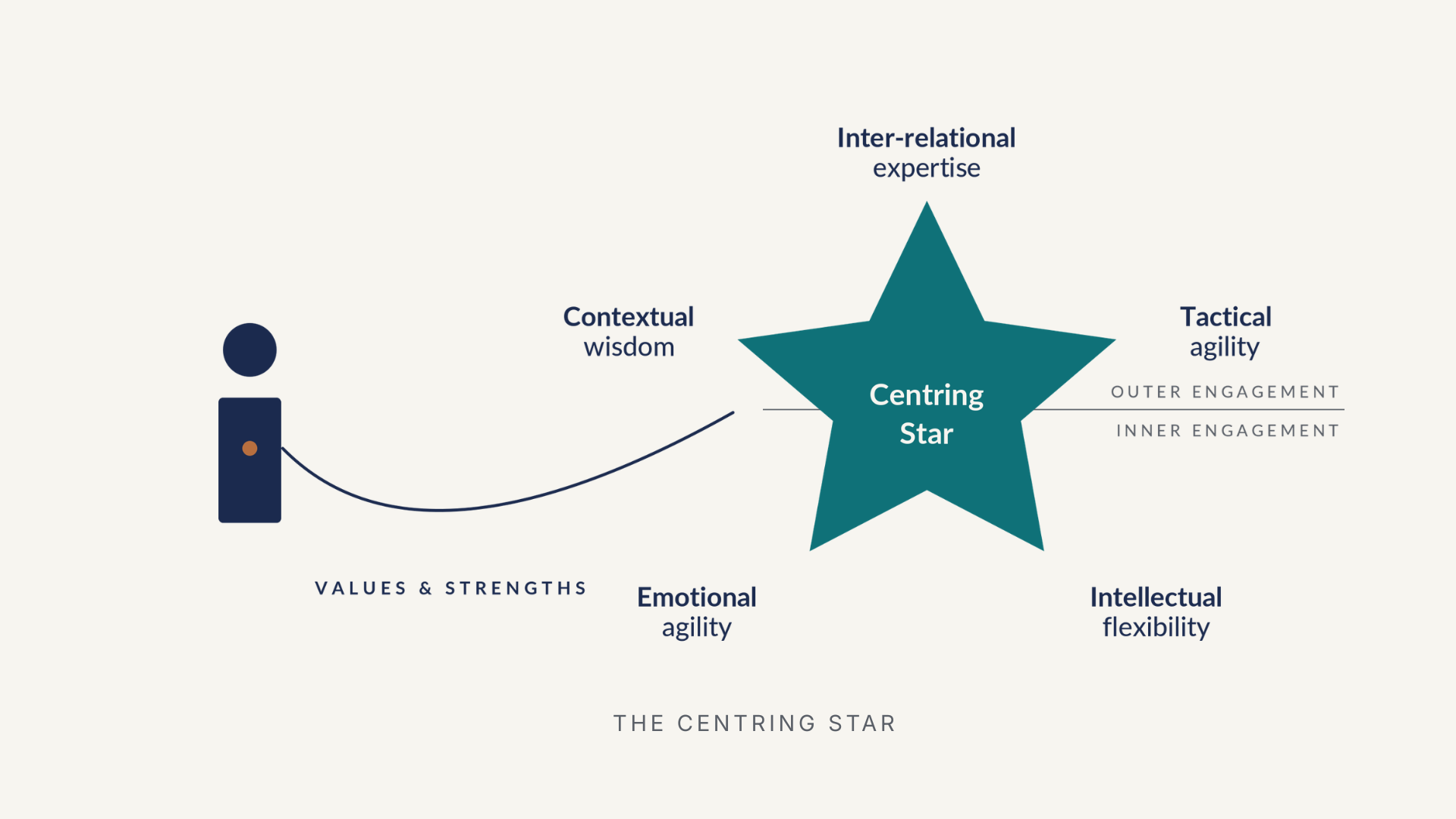
The tether attached to the Centring Star is what you use to hold yourself to yourself when conditions are tough. Your values. The standard you set for the kind of leader you intend to be when nobody is watching.
When the tether is intact, even hard decisions stay legible. You can explain them to yourself in five years. When the tether frays, the next decision becomes harder to read, because you are using the previous compromised one as your reference point.
In senior leadership, that tether allows you to look in the mirror without flinching, so that you avoid a sequence of small trades that look reasonable on the day and look different in the rearview.
John Smith is frightening because he is competent but untethered.
His story arc is a warning. When pressure rises, can you still recognise the line you said you would not cross?
Why peers help
These are hard to answer honestly when you only have a partial view.
For the past year I have been hosting a quarterly breakfast for NGO CEOs in health and community services. What people keep telling me is that the room of peers does something valuable. It provides a different read on the system and opens options as the system shifts around them.
Lately I have been thinking about what that experience would do for the senior leaders who report to those CEOs. They are often reading the system from one seat, with a narrow peer network of their own.