

What are you missing right in front of you?
When I was a kid, my aunt loved to tell a story about one of the few times my father had too much to drink. He became fixated on the idea that he wanted a ham sandwich. They didn’t have any ham, so they gave him something else. He didn’t notice. He got what he expected to see, and he was delighted.
It still makes me laugh, and wince a little. Because when we’re leading under pressure, we often do the same thing. We see what we expect to see.
When we’re focused on results, KPIs, and delivery, our attention narrows. We start filtering what’s in front of us through the assumptions we already hold. If we expect someone to underperform, we’ll find the evidence. If we assume a project is fine, we’ll see what supports that belief.
And when conditions shift, we can miss what’s right in front of us.
We might be facing challenges that look new on the global stage, but this leadership trap isn’t. Back in 1949, psychologists Jerome Bruner and Leo Postman ran a study using a trick deck of playing cards. They slipped in red spades and black hearts. Most people confidently reported seeing what they expected. Only about ten per cent paused long enough to notice that something was off. The rest described those impossible cards as if they were normal.
It’s an old study, but it exposes a big truth about how easily our expectations distort what we see.
Why intellectual flexibility matters
When we’re under pressure to perform, our attention narrows. We double down on familiar patterns. We draw on yesterday’s logic to help us with today’s problems.
Adam Grant talks about this in his book Think Again, where he explores how questioning our own thinking helps us adapt faster. He put it simply on LinkedIn:
“The faster you acknowledge when you’re wrong, the faster you can move toward being right.”
— Adam Grant
That’s why Intellectual Flexibility has earned its point in the Centring Star. It’s what helps leaders keep adjusting their thinking when the ground keeps moving.
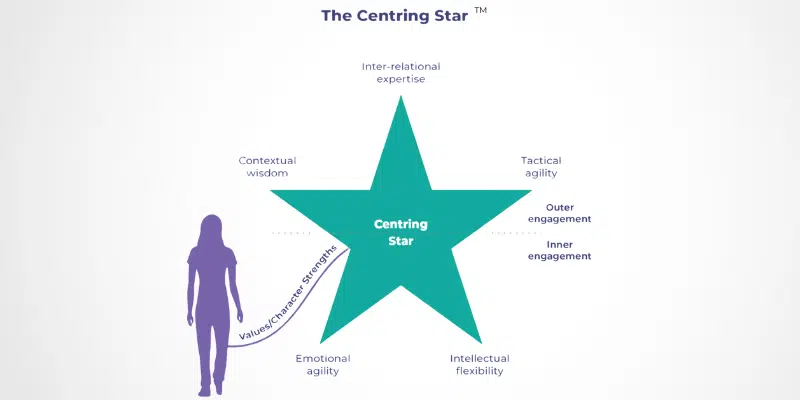
Staying centred when the ground shifts
But it takes awareness. Blinkers can help a horse stay calm in a crowded field, but they also block the moment a runaway horse is about to burst onto the track.

So before you push for the next milestone or performance target, it might be worth pausing to ask:
- How could the story you’ve told yourself be getting in the way of results and slowing progress?
- What would happen if you tested an assumption before pushing harder on a KPI that’s off-course?
- When the context feels familiar, who in your team can help you look again to spot the card that doesn’t belong in the deck?
Intellectual Flexibility isn’t about staying centred. None of us do that. It’s about returning to centre, seeing clearly even for a moment, before stepping back into the storm.