


I keep seeing the same pattern in stakeholder conversations across the system.
People work hard to resolve issues. Fixes are put in place.
And the underlying friction continues because each group works on the part they can see most clearly.
What looks to some like a fixable problem, is a tension between two things the system needs at the same time.
When leaders treat these tensions as problems to fix once and for all, they can burn time, create rework, strain trust, and still watch the issue return in another form.
Why effort still misses the mark
Senior leaders can waste a lot of time and political capital trying to land a final fix on something that needs ongoing adjustment instead.
When that happens, one side gets pushed harder. The benefits show up for a while. Then the downsides appear.
Trust takes a hit. Rework creeps in. People dig in around their own view. The problem recurs.
This shows up in tensions like program consistency and local flexibility, or control and enablement.
These are not opposite ends of a scale where one side is right and the other is wrong.
Each side is there for a reason. Push too far toward either one and the downsides start to show.
What the research says
Barry Johnson, who developed Polarity Thinking®, described polarities as:
“Ongoing, chronic issue that are unavoidable and unsolvable.”
— Barry Johnson
His point was not that leaders are powerless. It was that some issues get worse when we treat them like problems with a once-and-for-all solution.
Wendy Smith and Marianne Lewis’s research on paradox shows that some tensions persist because they are built into the work itself, not because someone has failed to solve them.
That is why hard issues can keep resurfacing even after smart people spend serious time trying to fix them.
Steering, not arriving
I think of this as steering, rather than arriving.
On a winding road, you do not solve steering in the first five minutes and then move on. You keep adjusting as the conditions change.
Lean too far one way and you create a new problem the other way.
That is what these tensions are like.
The task is to understand the value each side needs to protect, notice the downside when one side starts to dominate, and adjust before the system starts pulling against itself.
Problem or polarity?
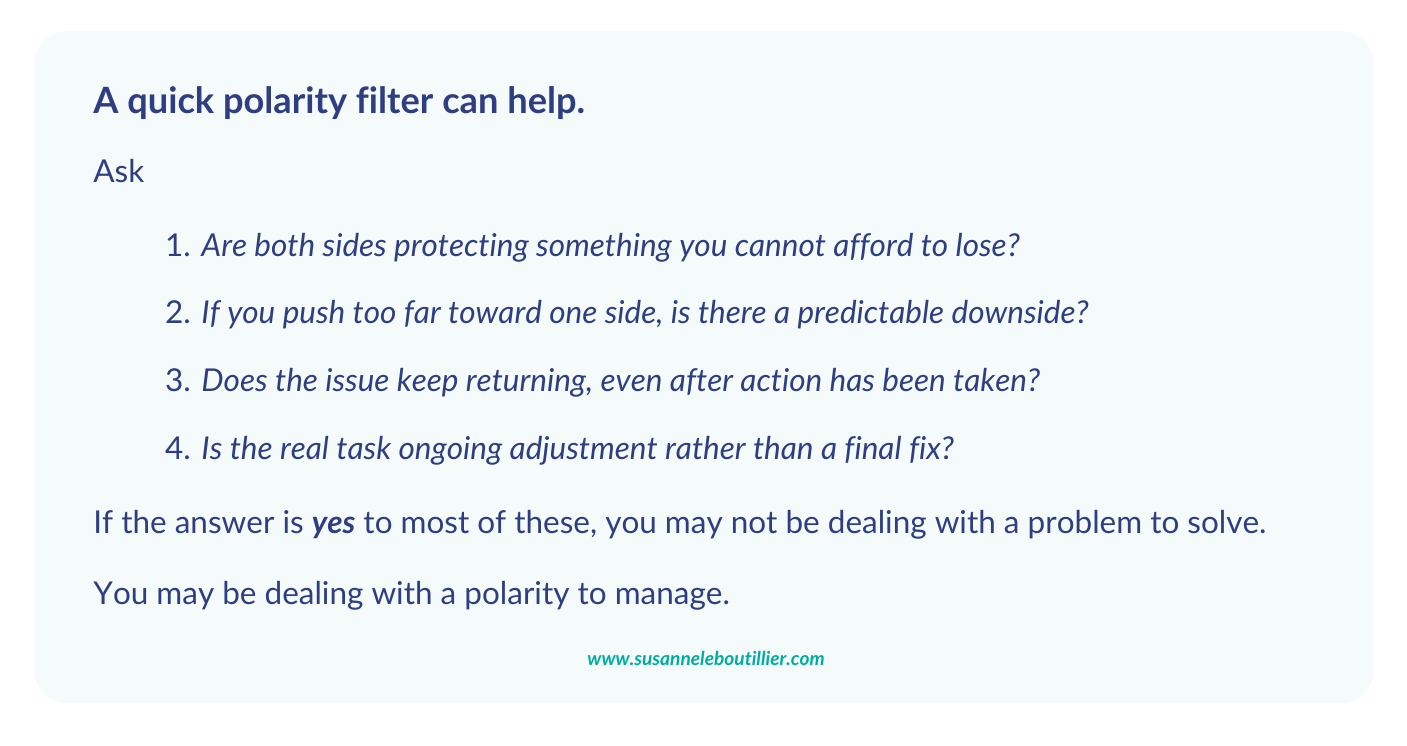
Getting started with managing the polarity
Choose one polarity that feels especially relevant to your day-to-day work and ask:
- If you could only make one shift to better balance this polarity, what would it be?
- What is one strategic but practical thing you could stop doing, start doing, or do differently that would reduce pressure or improve trust?
- Where do you already have the capability or tools to make this shift, but have not been using them with enough discipline or consistency?