

Clearing Out Old Thinking
Like many people, I’ve been in a mood to clean things out.
Not surface cleaning but the kind where you go digging into drawers, folders, and old files that haven’t been touched in years.
In one of those piles, I found a folder from the Harvard Business School Women’s Leadership Forum I attended in 2013. I was drawn to old handwritten notes, inputs from my Board of Advisors. Pages, which at the time significantly influenced how I showed up as a leader.
As I sat reading through them, a Søren Kierkegaard quote they used in the opening session grabbed my attention:
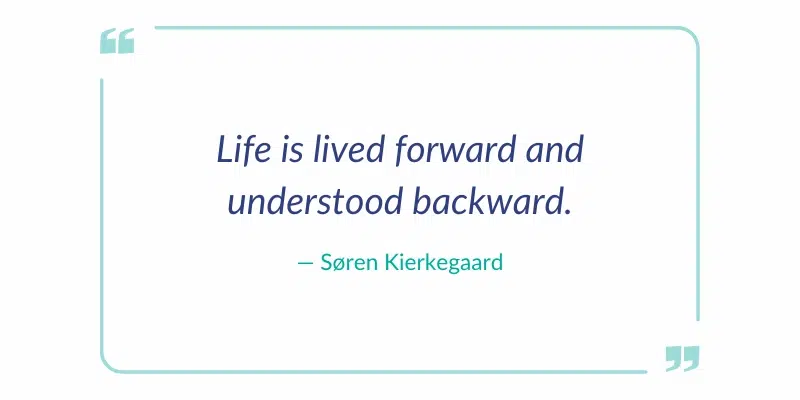
That was a period when I was starting to notice something about myself. How much meeting other people’s expectations drove me. How much energy went into not letting people down. How closely that sat alongside my values, my goals, and my sense of purpose.
Knowing Isn’t The Same As Acting
There’s a difference between awareness and action.
I could see the pattern back then. I knew what was driving me.
What I underestimated was the impact of worries that I would let down people I respected. And how easily that worry could override the judgement I would normally exercise.
Awareness was there. What didn’t hold was action.
When Everyone Needs You To Move
I was in a situation where senior people above me were under intense scrutiny, had a clear view of the outcome, and expected me to implement. Experts in our team were confident in the advice they were giving.
I was worried about letting people down. And not moving fast enough would do that.
So, I trusted the surrounding experts and didn’t slow down to ask the questions I used to insist on.
I didn’t ask the experts in our team why they believed what they believed to be true.
At the end of the day, I was the last link in the chain. I could have broken it, but didn’t.
When everyone is under pressure, helping can feel more responsible than questioning.
That’s how untested assumptions can travel all the way to the final signature, and the consequences become the leader’s problem to carry.
Why This Keeps Happening
There’s research that supports how you can avoid this in a very practical way.
Work by Philip Tetlockshows that judgement improves when people expect to explain how they reached a decision, not just defend the outcome. When process accountability is clear, people are more likely to test assumptions instead of borrowing confidence from others.
Pressure to deliver works in the opposite direction. It rewards momentum and makes any pause feel like a problem.
It also shifts the leader’s responsibility from exercising judgement to delivery that meets expectations.
The Final Signature
Every big decision has a final signature.
Lots of people contribute, advise and agree. But one person signs.
That signature doesn’t mean you did all the work. It means you own the decision.
It can be easy to forget that and assume collective confidence is enough when the pressure feels immense.
But once you sign, it’s yours.
Decision Ownership In 2026
As you think about 2026:
- Where are you the final signature, even when many others are involved?
- When you’re under heavy pressure from a leader above you, what do you prioritise first: helping or questioning?
- Whose confidence do you tend to rely on when things are moving fast?
- Which questions protect your judgement that you tend to drop when people are leaning on you?
- What will you do differently when the pressure hits in 2026?