
Years ago, I learned to ride a motorbike. I’m not the most coordinated person and my husband has been known to make rude comments about my ability to balance any two wheeled bike, let alone one with an engine. So, given my lack of natural talent I did an extra rider safety course.
The part that I’ve applied beyond riding is that the bike follows where you look.
Coming into a corner, the instinct is to watch the thing that worries you. The car that might pull out, the pothole you want to miss, the gravel washed onto the road edge. The problem is that the bike goes where your eyes go. Fix on the gravel and you steer straight into it.
Boards and executive teams do the same thing with the signals in front of them. Eyes everywhere, steering nowhere.
A plan that covers everything
I’ve noticed that some NGO strategic plans make the same mistake. They are built to look at everything at once.
They tend to be mapped against a capability framework, a tidy list of everything a well-run organisation should have in place. Governance, workforce, systems, engagement, financial sustainability, and so on down the page. Each one gets an objective and a few actions. It describes an organisation that wants to be seen as competent rather than a set of choices this organisation has made about its future.
The problem is that the plan that looks at everything at once cannot be implemented when resourcing tightens, which for many organisations is happening right now. A plan that covers everything prioritises nothing. Every line looks reasonable.
So, the board and the executive team keep scanning how they’re going against that whole page, while the organisation stops looking for the line it can steer through into the future. Attention goes to a member complaint, or the organisation’s socials. None of it is the road ahead.
When every line is important, resourcing gets settled by who argues hardest rather than by what the organisation is most exposed to. And the activity that is hardest to stop is usually the one that has been running longest. This is not confined to one kind of organisation. PwC’s 2026 Global CEO Survey, which drew on 4,454 chief executives across 95 countries, found they spend 47 per cent of their time on issues with a horizon of less than a year, and only 16 per cent on decisions looking more than five years ahead. The near horizon takes the attention because it is making the most noise.
Find the risks that should drive the plan
Michael Porter, the Harvard strategy professor, got to the core of the issue when he said:
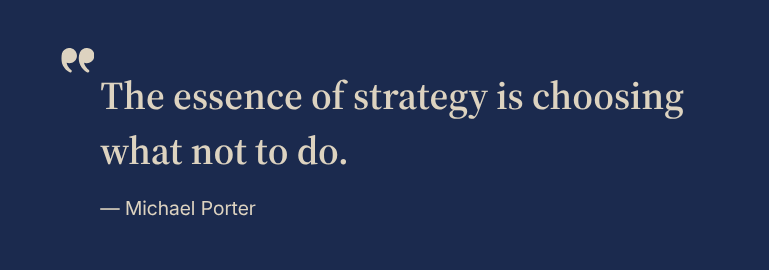
What changes an organisation’s position is rarely ticking everything off against that capability list. It is attending to the handful of risks that could stop you delivering on your mission.
If you’re worried your strategic plan looks like a map of organisational capabilities, the quickest way to course correct is to put the plan to one side temporarily and name your top five strategic risks. Not everything that could go wrong. The five that would hurt most if they landed, read against the signals in front of you. Funding that is shifting under you. Demand that is not only growing but getting more complex. Then ask if these are adequately managed. Not perfectly. Adequately.
A filter you can use this week
I ran the Queensland Health Reform Transition Office when the department was split into seventeen entities. Eighty thousand staff, a ten billion dollar budget, and more than three hundred high level deliverables being tracked.
The progress report against all three hundred still went to the transition board. The meeting itself turned on five risks, the five most likely to stop us getting there. That is what the board spent its time on, meeting after meeting.
You do not need to rewrite anything to start.
Take the activity your organisation currently has underway. Score each item from one to ten on a single question:
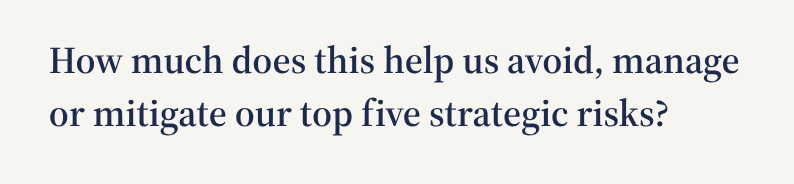
You will often find the most defended activities score the lowest. That is uncomfortable, and it is the point. The high scores are the plan you are already running.
There is one more question the scoring can miss. Your five will not turn up one at a time. Funding tightening, demand growing and getting more complex, having to demonstrate impact. They arrive together, and dealing with one can leave you less room to deal with the next.
So, after you have scored the five, ask which two or three could land in the same year, and whether your answer to one makes you more exposed to another.
That is the conversation I run with boards and executive teams: working out which pressures are likely to arrive together, and what that means for where attention and money go.
Done well, this gives a board and an executive team a shorter list they can defend, and a reason to say no that holds when someone pushes back.
The Convergence Trap field guide sets out the pressures converging on NGO health and human services and the questions that surface how they interact. You can download it below, no email address required.
If your organisation is heading into a planning cycle and the list is longer than your capacity to deliver it, reach out and tell me what is converging for you.