
Early in our marriage, my husband had a routine for asking about a night out with his workmates. He would decide he wanted to go. Then he would spend days deciding how to tell me.
He had good reason or thought he did. He’d watched the other blokes at work plan the same nights out, and their wives were not enthusiastic. So he would rehearse what he wanted to say, choose his moment, and brace for a response he had already written on my behalf. By the time he told me, he’d been carrying the conversation around in his head for a week.
When he finally said something, the response surprised him. I didn’t mind the night out. What bothered me was short notice. If I heard on Thursday about a Friday night, I had no chance to make plans of my own. He had access to years of evidence about how wives respond. None of it was about me.
Leaders do the same thing, with less time and more at stake, and an untested story can soon start making decisions for you.
Forty-five minutes of the wrong story
Those stories are written by assumptions and insecurities, and they get written fast. A meeting you weren’t told about. A one-line reply to the email you spent an hour on. The interpretation arrives before you realise, and it feels like fact.
An executive I’ve worked with watched a meeting they expected to lead run for forty-five minutes without them. A colleague fronted it end to end. No handover, no gap they could step into. They spent the whole meeting building the case in their head: they had been cut out, it was deliberate, and it said something about where they stood.
In all that time, one question never got asked: how do I know that to be true?
The next day they raised it, carefully. They gave the colleague credit for how well the meeting had run, then said they had felt like they weren’t in the meeting at all.
The colleague was horrified. The executive’s video had dropped in the opening minutes. The colleague assumed they had been pulled away by an emergency and ran the whole thing solo to
cover for them. They had spent forty-five minutes being excluded from a meeting that, as far as the colleague knew, they had left in the first two.
The story you build about a colleague’s behaviour in real time is rarely the whole story. The only reason they learned the truth is that they raised it before the story set.
And it did more than clear up one meeting. The two executives share responsibility for the same outcomes, and the trust between them grew because the story was tested instead of left to set.
Stories set like concrete
A fresh story behaves like wet concrete. While it is wet, it moves. One question can reshape it completely. Leave it overnight and it starts to set. Leave it a week and you are no longer correcting a misreading; you are breaking up a slab.
A set story also gets built on. You share a little less with that colleague. You read their emails with a different eye. You start double-checking things you used to take on trust. They never know a verdict was reached, so they never get the chance to appeal it.
Roderick Kramer, a Stanford professor who studies trust and distrust in organisations, has a name for what can follow: the sinister attribution error. When people feel under scrutiny, they can overestimate how much of others’ attention is directed at them, personalise ambiguous behaviour and infer negative intent where none may exist. Senior roles bring plenty of visibility and scrutiny, so the conditions can be readily present.
Indra Nooyi, who led PepsiCo for twelve years, called the advice her father gave her the best she ever received:
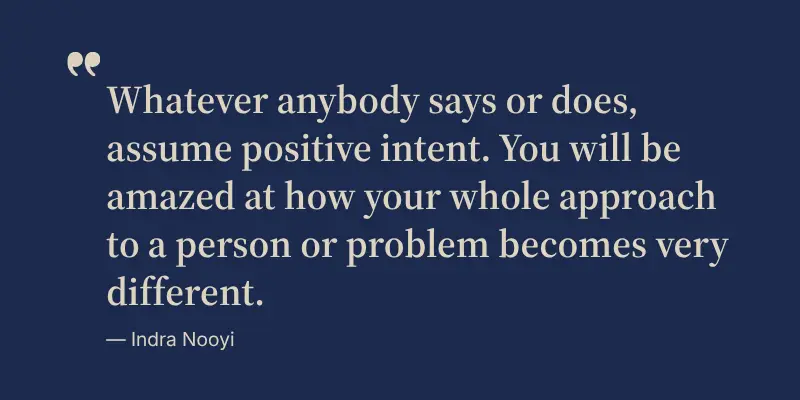
Assuming positive intent keeps the concrete wet long enough for you to ask.
Say it before it sets
There are two moves I recommend, and speed is the point of both.
First, test your version against itself: what else would have to be true for your story to hold? For my husband’s story to hold, I would have needed to be a different person from the one he was married
to. For the executive’s story to hold, a colleague who had never once played games would have needed to choose a meeting with external guests as the place to start.
Then say it to the person, within a day if you can. The shape the executive used works anywhere: what happened, how it landed on you, and a question that lets the other person fill in what you cannot see. The executive led with giving credit and sharing a feeling rather than laying a charge in front of the other person, which is why the conversation produced the truth instead of a defence.
The same discipline scales in other situations. The story you are carrying about your funder’s intentions, or about why the board keeps circling one topic, is written the same way, and sets while you work around it. Run it through the same question: what else would have to be true for your version to hold? Then seek out the conversation that tests it, before you build a response on a story nobody has checked.
The more senior your role, the more of your reads get built alone. Fewer people see what you see, and the ones who could correct your story rarely know it exists. That is manageable when the story is about one meeting. It is a bigger problem when the story is about your funder, your board, or where your organisation stands, and it is setting while you carry it on your own.
Untested stories do more than strain a working relationship. At senior level they shape strategy: how you read a funder, what you take from a board’s hesitation, which options get dismissed before anyone has examined them.
Lead Through Convergence is where senior leaders in NGO health, community and human services practise testing those reads. Participants bring the live issues narrowing their choices and work a practical method on them: assumptions tested earlier, stakeholders read more accurately, clearer decisions about what the organisation does next. The 90-day program starts on 10 September, with one workshop day in Brisbane and two virtual implementation labs.
If you need to lead through uncertainty and ambiguity, reach out and I will send you the details.