
In 1991, Captain Billy Tyne of the Andrea Gail made a fatal decision. Faced with an incoming storm, a broken ice machine, and 40,000 pounds of fish on board, he chose to head into it—hoping to save the catch. What he didn’t know was that three weather systems were colliding into what would become the “Perfect Storm.” His decision cost the lives of every crew member on board.
Many leaders don’t face waves and wind like Billy Tyne did, but they do face storms—intense pressure, blurred visibility, and converging demands. And in the midst of these storms, they too must make decisions with far-reaching impact.
So how do we lead through our storms, without becoming lost in them?
In today’s context—shaped by rapid change, disruption, and ambiguity—leaders don’t need to be the strongest or smartest. They need to be the most centred. Because when the storm hits, it’s not just the strategy that keeps you steady. It’s how well you can return to your centre, again and again.
Centred leaders don’t waste energy trying to control the uncontrollable. Instead, they align their inner and outer worlds to respond with calm clarity, rather than react out of fear, ego or exhaustion.
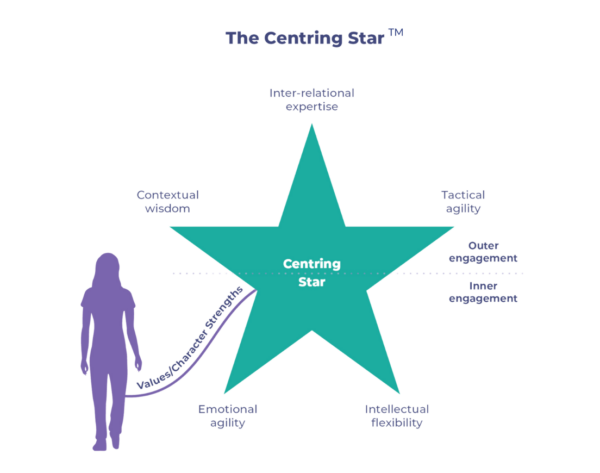
Imagine your leadership as a tall ship at sea. Your Centring Star sits high in the sky—a constant you can steer by, even when the waves rise. Your values and character strengths are the tether that secures you to the Centring Star – your compass.
No storm lasts forever. The skill is in learning how to sail from one eye of the storm to the next—and not be overwhelmed by the waves between them.
The evidence is clear: leaders who can manage complexity with adaptability and clarity have greater performance outcomes, lower stress levels, and higher trust from their teams.
McKinsey’s research on organisational resilience following the COVID-19 pandemic reveals that resilient companies with adaptable leaders exhibit better shareholder returns and outperform their peers in integrating new technologies, supporting customers, building partnerships, and attracting and retaining employees.
Emotional agility, intellectual flexibility, contextual wisdom, inter-relational expertise and tactical agility are no longer optional—they’re essential tools for today’s leaders.
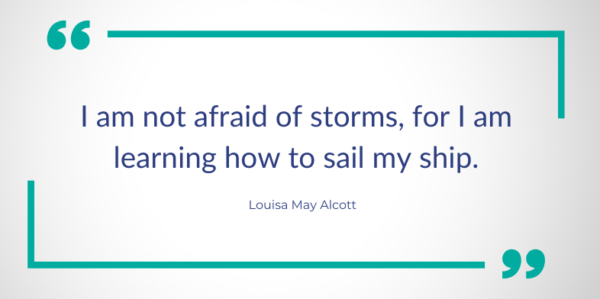
And yet, so many leaders still believe they must have all the answers. That’s why I keep coming back to this quote from the author of Little Women:
The storms aren’t going away. But you can become the kind of leader who knows how to navigate through them—anchored by your values, responsive to your context, and confident in your next right step.
The Centring Star framework is here to support that journey. It’s a practical, powerful tool to help you:
- Strengthen emotional agility and decision-making under pressure
- Lead with intention rather than reaction
- Stay tethered to your values—even in turbulent times.
Curious how this might support your leadership or build resilience in your team? Let’s have a conversation.