

In the late 2000s, my BlackBerry was practically an extension of my hand. As a Government Executive, it was my direct line to work—meetings, emails, urgent messages—all at my fingertips. BlackBerry was the gold standard at the time, and its company leadership was convinced of its dominance.
But conviction isn’t the same as foresight. While BlackBerry stayed anchored to its keyboard-centric design and security-first approach, the world was shifting. Apple and Google were investing in touchscreen technology, seamless user experiences, and an app-driven future. The data showed clear signals, but BlackBerry’s leaders trusted instinct over probability. They dismissed the likelihood that consumer preferences—not corporate priorities—would dictate the market’s evolution.
Fast forward a few years, and the industry had moved on. BlackBerry, once ubiquitous, became obsolete. Today, my lifeline is an iPhone—something I never saw coming back then. The lesson? Past success can be a powerful blinder, and gut instinct alone won’t protect us from an evolving reality.
As leaders, we operate in complexity. Decisions rarely come with clear-cut answers. Do we push forward with the new initiative, hold back, or pivot? Do we trust experience, or take a calculated risk?
The goal isn’t certainty—it’s reducing our margin of error over time. That’s where probabilistic thinking becomes invaluable.
Dr. Joel Pearson, a cognitive neuroscientist at the University of NSW, studies how intuition forms. His research reveals that instinct can serve us well in stable, familiar environments, but it becomes unreliable in complex, uncertain conditions.
“Intuition is a shortcut the brain takes when information is incomplete. But in unpredictable contexts, these shortcuts often lead us astray,” Pearson explains in his book The Intuition Toolkit.

Think of decision-making as poker, not chess. Chess is a game of full visibility—every piece on the board can be accounted for, and moves can be calculated. Poker, however, involves hidden information, shifting odds, and incomplete data. The best players don’t rely on gut feelings; they assess risk, adapt, and make decisions based on probabilities.
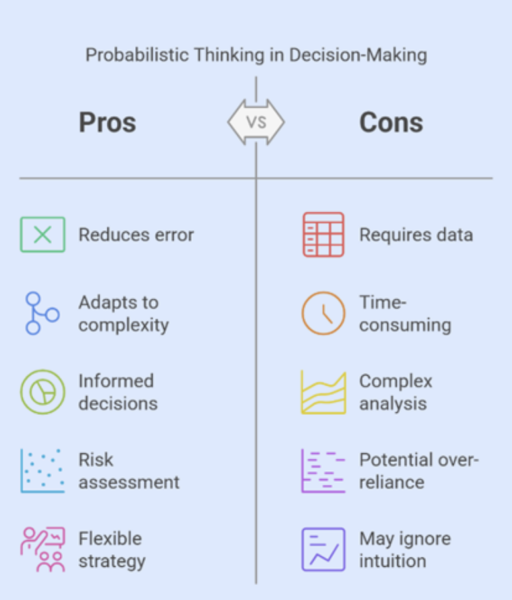
The Pitfalls and Benefits of Probabilistic Thinking
Pitfalls:
- Humans crave certainty, making this mindset shift uncomfortable.
- It can feel counterintuitive when quick decisions are needed.
- It requires continuous learning and adjustment.
Benefits:
- Helps leaders avoid overconfidence bias.
- Encourages adaptability in fast-changing environments.
- Supports long-term decision-making by focusing on likelihoods rather than absolutes.
Here are three ways you can strengthen your probabilistic thinking:
- Make Small Bets Instead of Big Leaps – Instead of committing entirely to one path, test different strategies, gather real feedback, and refine your approach.
- Apply Bayes’ Rule to Your Leadership – Update your beliefs based on new evidence rather than clinging to initial assumptions.
- Create a Culture of Forecasting – Encourage your team to assign probabilities to different scenarios rather than making black-and-white predictions.
The best leaders don’t aim for perfect predictions—they focus on being less wrong over time.
Next time you’re faced with an uncertain decision, pause and ask: What does the data suggest is most likely to happen? Your instinct might resist, but your future self will thank you.
A leader with good tactical agility knows when to lean into their intuition and when to favour probability-based thinking.
What’s a recent decision where probability-based thinking could have helped you? I’d love to hear your thoughts.