
A few years ago, I worked with a leadership team that prided themselves on their ability to “move quickly.” They’d shifted direction three times in six months. Each change in direction came with a sense of urgency, a motivational all-hands meeting, and a new mantra. But beneath the surface? Fatigue. Frustration. Quiet disengagement.
One senior leader confided: “We never actually land anything. We’re always halfway through something new before the last thing has had a chance to take hold. The pace is impressive—but it’s all spin and no traction.”
That sentence stuck with me.
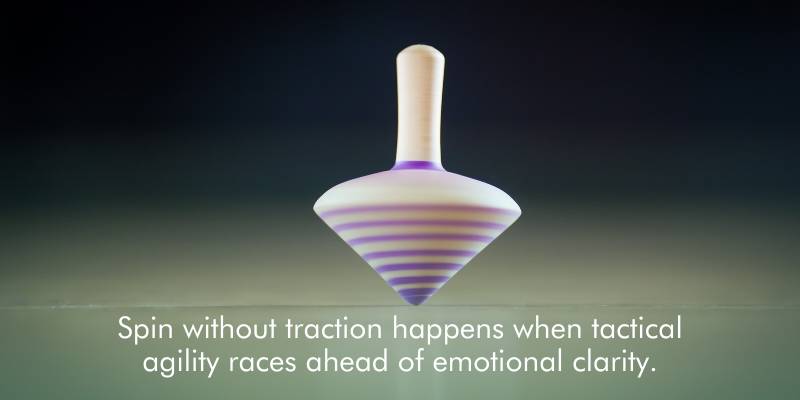
Spin and no traction. It describes what happens when tactical agility is disconnected from emotional clarity.
Agility isn’t just about moving fast. It’s about moving with direction and intention. And that means leaders need emotional clarity—otherwise, they’re just creating motion, not movement.
It’s like sailing a yacht in high wind.
You can constantly trim the sails, shift course, and stay busy… But if you haven’t taken a moment to check your compass, and point your tiller in the right direction, you’re just tacking in circles. And your crew? Exhausted and confused.
Emotional agility is the compass. It allows you to pause, reflect, and ask: Is this decision coming from insight… or from discomfort?

When emotional clarity is present, tactical agility becomes:
- Purposeful – every shift serves a deeper intent
- Credible – teams understand the “why”
- Sustainable – the pace aligns with the people and change fatigue is minimised
Without it?
- You pivot out of anxiety
- Your team feels whiplashed and withdraws
- Projects multiply, but nothing lands
- Your leadership brand starts to feel reactive—not strategic.
The result? A culture of confusion masquerading as innovation.
Ron Ashkenas explains that churn happens when “leaders pay so much attention to the means of achieving a goal that they (and their teams) lose focus on the end result” in the article How to Avoid the Churn That Comes With Agility.
Unfortunately, speed can be meaningless movement, according to Dr Susan David.
“Agility without direction is just speed. Emotional clarity gives your movement meaning.”
— Susan David, PhD, Harvard Medical School Psychologist & author of Emotional Agility
However, a 2018 Korn Ferry Institute publication revealed that leaders with high emotional self-awareness are significantly more likely to foster top-performing teams, with 62% of them creating optimal work environments compared to just 5% of leaders with low emotional self-awareness.

If you’re frequently changing direction, not seeing progress, and want to increase your emotional self-awareness…
Ask yourself:
- What emotion is driving this shift—curiosity, fear, urgency?
- Have I shared the “why” clearly with my team, or just the “what”?
- Do I need to move—or do I need to pause, reflect, and realign first?
Here’s what helps:
- Establish a regular check-in practice before major shifts
- Get honest feedback from your team about how they’re experiencing the pace
- Create space to process your own pressure before setting the next direction.
Want help turning constant motion into real momentum?
I work with senior leaders and executive teams to develop the emotional clarity and contextual wisdom that drive sustainable agility—without the spin.
If you’re ready to shift gears with intention, let’s talk.