
My work often puts me on a plane. Over the past year I have flown to a lot of different parts of Australia, and a pattern has shown up that I can almost set my calendar by. Within about a week of a flight, I come down with something. A cold, a cough, whatever was going around in that pressurised cabin.
I worked out what to do about it a while ago. I bought a mask and started putting it in my bag for every flight. It is there now. It has been there for months.
I have not once put it on.
I think about it as I am driving to the airport. I know the mask will be in the bag, a seat-pocket away from my face. And yet, I still leave it there. A week later I am feeling under the weather, mildly annoyed at myself, again.
I see the same happening in organisations. A risk gets named. Someone takes the first step. And the rest never happens.
The step that lets everyone feel covered
We tend to assume the danger with a serious risk is that people miss it. Sometimes they do. More often, in the organisations I work with, the risk is named clearly and early. People can see it. They even start to prepare. A working group is formed. A board paper is commissioned. The item goes on the next agenda.
Then the preparing starts to stand in for the deciding. The working group becomes proof the board took it seriously. The paper becomes proof someone is across it. Everyone feels covered, and the response itself, the part that costs something and changes the exposure, keeps getting pushed to another meeting or time.
The mask in my bag does the same job for me. Putting it in my bag lets me feel I’ve dealt with the problem. Putting it in the bag was the easy part. Wearing it is the part that works, and the part I avoid.
For NGO health and human services boards, this is where the pattern turns dangerous. Funding flexibility is tightening. The cost base is rising faster than agreements index. Commissioning is going through a reset. Many boards can see each of these coming. Many have named them. Blindness is rarely the problem.
What turns those separate pressures into a trap is the way they interact. This is the Convergence Trap: the pressures are visible early, but their combined effect is underestimated until the time to respond has run short. The World Economic Forum describes the same pattern at a global scale, calling a cluster of interacting risks a polycrisis:
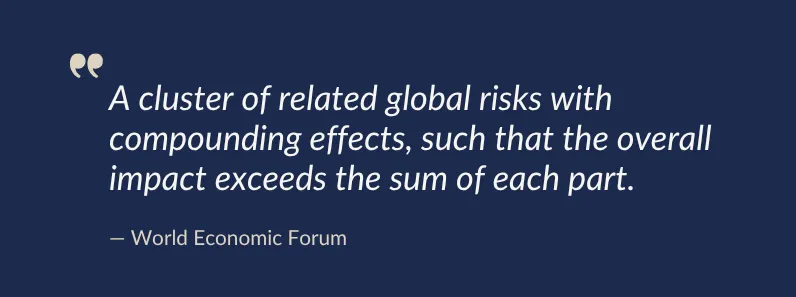
For a board, the trap is in the timing. The pressures arrive together, and each one shortens the time you have to deal with the others. The window you assumed you had is smaller than it looks. By the time the decision is forced, the stakes have grown past money. Viability is in play: contracts that go to someone else, demand they can no longer meet, a service struggling to live within its means.
Across business more broadly, the gap between seeing and acting is wide. The World Economic Forum’s work with McKinsey, drawn from more than 250 organisations, found 84 per cent felt unprepared for the disruptions ahead, and only 13 per cent had built resilience into their strategy in any complete way. In the strategy work I do with boards; the risk is rarely the thing they cannot see. It is the decision that keeps moving to the next meeting.
Work back from the outcome
The fix is not a longer risk register. Take the one you have and split it in two. One column for the things that prove you can see the risk coming, the other for the things that will change what happens if it hits. The gap between those columns is your current exposure, and on many registers it is wide.
Closing that gap is where boards can stall. Larry Bossidy, the former chief executive of Honeywell, and Ram Charan, a long-time adviser to boards and chief executives, made it the subject of their book Execution. As they put it:
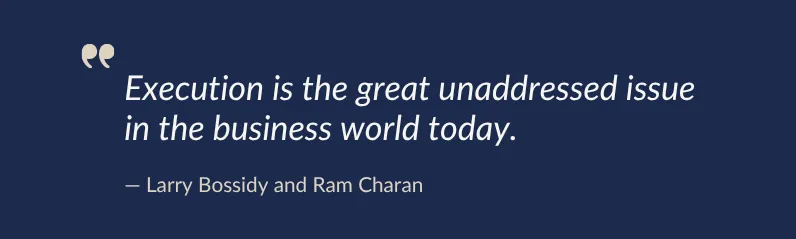
The move I make starts from the outcome. Stand a few years out, with the pressure dealt with, and describe what you see. How would you know it had worked? What underpins that result, so it holds, given everything else moving at the same time? Then trace the path back from there to now.
The path back shows you the moves it will take, and how long each one needs. Set that against the time the converging risks are likely to leave you, and the decision stops being abstract. You can weigh the cost of acting now against the cost of waiting until the window closes. Working back from the outcome tells you something the register never will. Whether you still have time, and what the first move that changes your exposure has to be.
The mask in my bag will occasionally cost me a day in bed. For a board, leaving the equivalent of my mask in the bag is dearer, because the pressures will not wait their turn and they will not come back at a better time.
The Convergence Trap field guide sets out the pressures converging on NGO health and human services, and the conversations that turn naming them into deciding while there is still time to decide. It is the conversation I run with boards and executive teams.
If your board has named these risks but not yet moved on them, reach out before your next risk conversation and I will send you the field guide.