
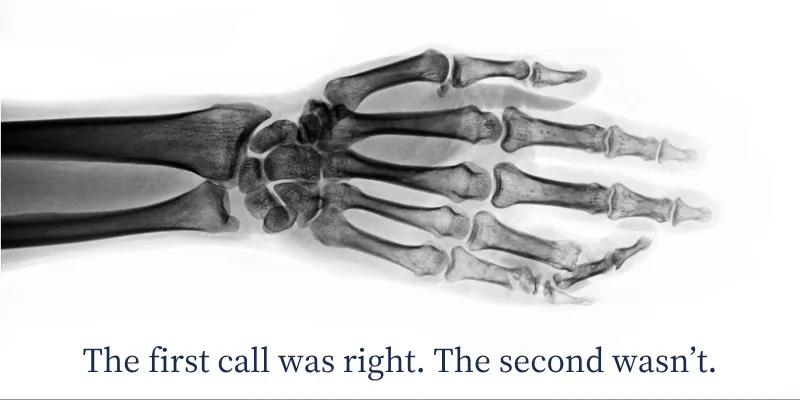
Most leaders don’t get into trouble because of the first decision.
They get into trouble because of the second one.
My daughter and her partner are both football mad. They have played since they were kids. She caught the AFL bug in her early teens and plays in a women’s team here in Brisbane. He plays NRL. Different codes, different rhythms, and somehow it works. It helps that she is also a huge Brisbane Broncos supporter. Otherwise, I don’t think their relationship would survive.
Recently, in the warm-up before his game, an incoming ball jarred his finger. He knew straight away something was wrong. The finger was not sitting right. He grabbed it, yanked it back into place, and played the full game. Full of heart, which is typical of him.
Later at the hospital, when the x-rays came back, the doctor told him yanking it back was the right call. Playing on probably was not.
He went into surgery. The surgeon rebuilt his shattered finger and his life went on pause, as he figured out how to fill the time while it healed.
Two decisions, made in a few seconds
I’ve been thinking about the decisions he made before he ran on the field to play.
There were two, made by the same person, inside the same few seconds. One was sound. The other was not. The doctor named them both.
The first call, the yank-it-back, came from instinct. It happened to be right. He was praised for it.
The second call, the play-on, came from momentum. He was ready to go on the field. The game was starting. He didn’t want to let his team down. The decision to keep playing was barely a decision. But it carried significant consequences.
What this looks like for senior leaders
This is the territory I work in with senior leaders: the moment after the first decision, when you have momentum, the pressure is rising, and the next move will either protect progress or compound damage. It shows up later, on the x-ray.
Most leaders do not fail at the first call. They lose it on the second, third or fourth, all made on the momentum of the first.
The second call is harder. By then, the adrenaline of the first decision is doing the steering. The team is set, everything is moving. The discipline of pausing to read the situation again, before the next move, is the one that costs the most when it’s dropped.
By the time the damage shows up, it rarely looks like a decision problem. It looks like something else. A stakeholder who should have been approached differently, a contract that should have been renegotiated when there was still time, a team member who has disengaged, a reform decision that now needs expensive rework.
What the research calls it
Behavioural science has a name for the pattern. In Knee-Deep in the Big Muddy Barry Staw described what he called escalation of commitment: the tendency for people to keep investing in a course of action they have already started, even when the situation in front of them suggests stopping would be the better call.
The idea still holds, but it’s been refined: leaders do not always double down because they are irrational. They double down when the setting rewards defence over learning, when reputation is tangled up with the choice, when stopping looks like waste, or when the next step has not been made thinkable.
It’s a pattern I see showing up inside leadership teams.
The discipline of finding the stands
From the stands, a game looks different. The patterns are visible. The coach can see what the player on the field cannot. That is not because the coach is more capable. It is because the coach is sitting somewhere the player cannot reach while the game is on.
The discipline of the second call is the discipline of finding the stands for a few seconds, even when you cannot leave the field.
Jeff Bezos has named this in business terms. In his 2016 letter to Amazon shareholders he wrote:
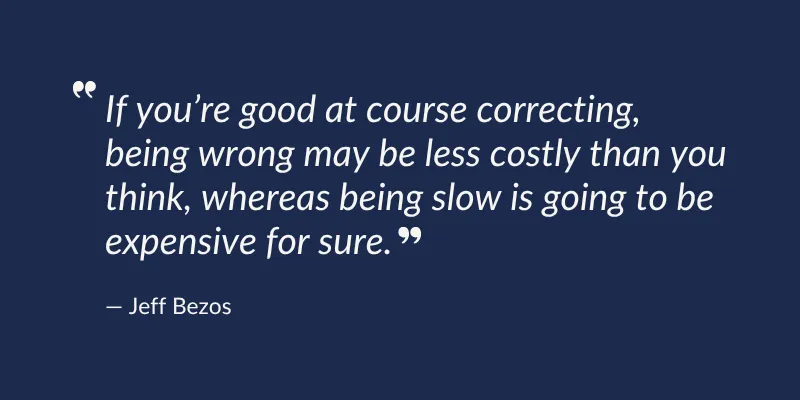
Course correction is the leader’s version of looking at the game from above. It is a different muscle from decisiveness, and it does not come with the same applause.
A short test before the second call
Two questions to ask before the next move.
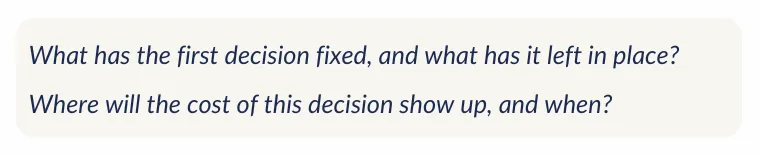
These questions take seconds to ask. They are the equivalent of taking a closer look at your finger before you run back onto the field.
If this is your territory
This is part of what I speak and advise on. It is also why I created Lead Through Convergence.
It is for senior leaders in NGO health, community and human services who are already making high-pressure decisions across funding, workforce, regulation, commissioning and technology change when conditions will not sit still.
The program is built so that leaders pause at the second call, read what has shifted, and course-correct before momentum turns into avoidable damage.
The next public cohort begins in July in Brisbane.
Apply for the July cohort or reply to this email if it would be useful to talk through whether the program fits your context.