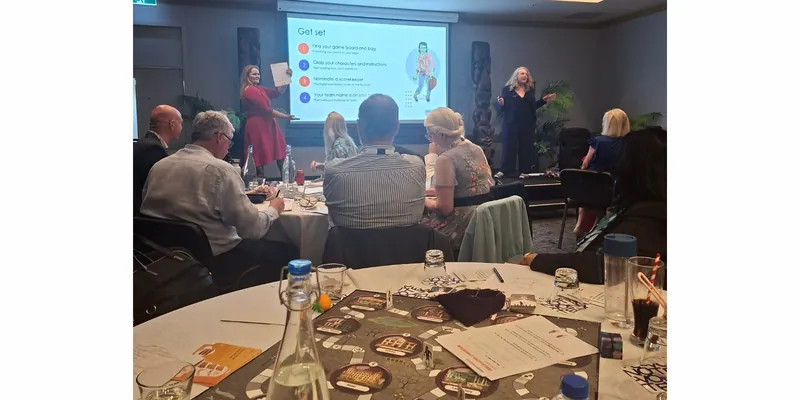
At the Professional Speakers Association of New Zealand convention in Auckland, Dr Samantha Rush and I ran a session for professional speakers from more than five countries.
At one table, a player became very upset with the people learning as they went. They hadn’t read all the instructions themselves, so they couldn’t be confident that the others were playing it right. The tension at that table was there for everyone to see.
Professional speakers are good at handling it when things go wrong. Earlier in the convention, we had watched people respond to tech failures: a video that wouldn’t play, sound on a slide that didn’t come through.
At lunch, we put the Ambiguity Apocalypse game on each table. When they came back, we told them there are your instructions, there is ten minutes on the clock, and you need to take a minimum number of turns.
People at the tables reacted in different ways. Afterwards, some people described the ten minutes as chaotic and disorienting. Others said it was fun.
It’s different to a video that won’t play. That is volatile because it is sudden and inconvenient, but you know what it is and what to do about it. The game was full of ambiguity and uncertainty: unfamiliar rules, time pressure and it was hard for people to get a feel for what to do quickly. These are people who handle volatility for a living, and the ambiguity and uncertainty still challenged some of the tables.
When your tolerance is higher than your team’s
When I completed the Indicator of Ambiguity (IAm) diagnostic, I came out with a high tolerance of ambiguity. Once I understood its three domains, I could see that being comfortable with not knowing wasn’t the same as managing the lack of certainty for my team. I wasn’t always picking up on what was going on for them below the surface.
What happened at those convention tables made the impact of ambiguity and uncertainty visible. At work It often isn’t. People rarely stop and say they can’t go on until they understand all the rules. They keep working and take the effects of not knowing home with them. You don’t see the sleepless nights, or what it is doing to them between one workday and the next.
At least there is an instruction sheet to quickly read when we play the game. At work, the people who need to understand the rules first are often left to work them out on their own.
Researchers at University College London measured how this uncertainty affects people in 2016. Forty-five volunteers played a computer game in which they could receive a mildly painful electric shock on the hand, and the odds of a shock kept changing. The tracking showed that people were most stressed when they believed the chance of a shock was 50/50, and least stressed when they felt sure either way.
The lead author, Archy de Berker, said:
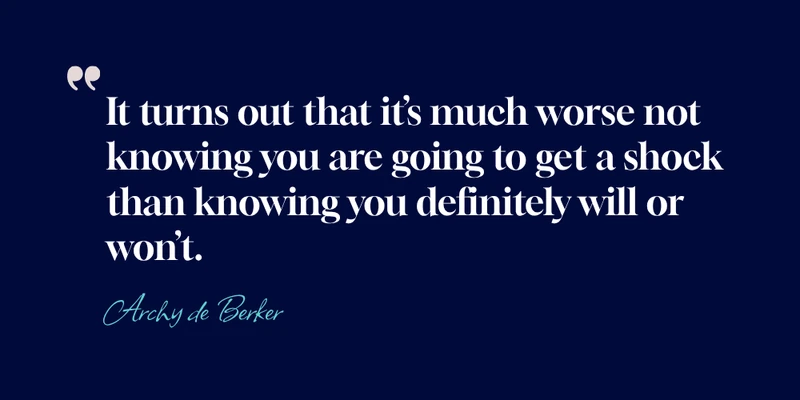
For a leader, leaving people weighing up the odds can cost them more than hearing hard news.
The pressure can build over time as new ambiguities and uncertainties get layered over the top. Then something small happens, a changed deadline or a short email, and someone’s reaction can look out of all proportion to what happened.
The odds of them letting you know it is brewing are not in your favour.
The Corporate Mental Health Alliance Australia and WTW surveyed 9,904 employees across 10 Australian organisations and six industry sectors in late 2024. Changes at work, role clarity and job security were among the experiences most often reported as having a negative impact on mental health. Yet, only about half felt safe raising these concerns within their organisation (51%) or with their manager (55%).
What to ask
When you’re comfortable with not knowing, don’t assume your team is. Ask the people on your team two questions: what are you having to work out at the moment without an answer, and when do you expect to have one? The first brings the unresolved questions into the open. The second shows you which of them have no end in sight, and those are the ones most likely to compound and affect people.
What to do with the answers
When you don’t have the answer, give people what you can of the instruction sheet: what is settled, what is still open, and when they will hear more. Then come back on that date whether or not there is news. A hard answer is easier to work with than none.
You won’t always be able to remove the uncertainty, but you can make sure people aren’t left to work it out on their own.
At the Auckland convention, people saw how differently they respond to uncertainty, even sitting at the same table with the same instructions. Some of them saw each other and themselves differently because of it.
I bring that experience to conferences and leadership events, as a keynote or an interactive session. Leaders see how differently their own people experience uncertainty when they are working through change without a static instruction sheet, and what they can do about it. If you are putting together a program for 2027, reach out and tell me what your people are dealing with.
Written with AI assistance. The thinking and the final wording are mine.