
My kids were born at a hospital birth centre. I felt like I’d won something when I got through the ballot. It was even better than I expected. We had the same midwife the whole way through for both kids and my husband there for all of it.
When our first child, a son, arrived, he looked like he had a very bad spray tan.
He was bright orange. Not officially premature, but a bit undercooked and not ready to feed. His bilirubin was high enough that he was borderline to go under the lights in the special care nursery.
Our midwife thought that if we could get him feeding, his body might start doing its job and he would not have to go.
Staying in the birth centre meant a midwife had to be on site. Nobody else was having a baby that night, so by the rules we should have moved across to the public ward and my husband should have gone home.
Our midwife decided to sleep in an empty birth suite instead, so the three of us could stay together.
I was working in industrial relations at the time, which is the only reason I understood what she risked, when I found out afterwards.

What she was risking
She was not on the roster. She wasn’t paid but she was there. And if something had happened to her while she was in the building, she wouldn’t have been covered by WorkCover.
Nothing about what she did was self-serving. She thought she was closing the gap between what the roster allowed and what her commitment to us required.
The hospital got the benefit, so did we. But the hospital was exposed, and the risk was hidden.
When I went back to work I started asking questions, and the answers were consistent. Midwives across the birth centre were filling the same gap the same way. Nobody had tried to hide it. And nobody had been asked if they were doing it.
I led the negotiations for the agreement that put a proper all-inclusive rate in place for midwives working there.
The part I think about now is how I came to know. I did not find out through an audit, and nobody raised it with me. I found out because I happened to be staying in that room with the right professional radar switched on.
That was luck rather than a process for identifying risk.
There is a reason it happens that way. The people closest to the gap are the least likely to raise it, because describing what they do can sound like confessing to a breach. So, the organisation finds out when something goes wrong, or when someone happens to ask.
Where this shows up now
Many organisations have a version of that midwife working somewhere this week.
Infoxchange surveyed 824 not-for-profits across Australia and New Zealand for its Digital Technology in the Not-for-Profit Sector Report, November 2025. Sixty-seven per cent were using generative AI. Eighty-five per cent did not have an AI policy, and half of those planned to develop one but had not yet.
So their AI practice arrived first, while governance was still in the queue behind it.
Most of that use will be someone drafting a report at nine at night to get it out the door, with good intent and under pressure. It is no different from staying over in the empty birth suite.
A ban doesn’t prevent any of it. It moves the practice somewhere you cannot see, and it leaves the person doing it in the shadows either holding the risk on their own or unwittingly exposing your organisation.
Two questions
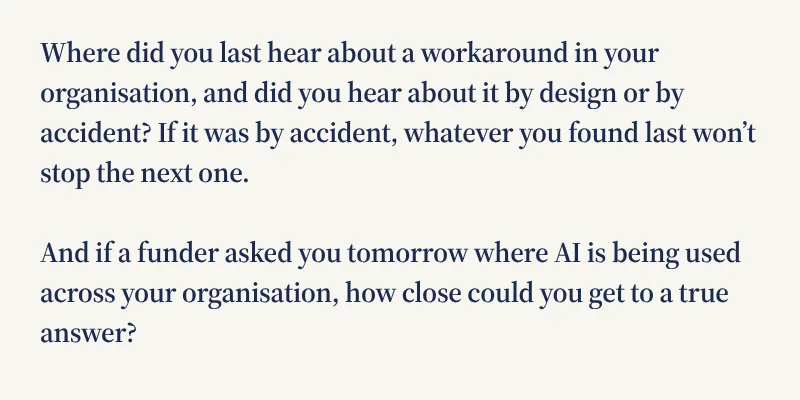
There is a date attached to that second question now. From 10 December 2026, organisations covered by the Privacy Act have to set out in their privacy policy the kinds of decisions they make using automated decision-making, and the kinds of personal information involved, including where the automation sits inside a vendor’s product rather than something you built. Eligibility, prioritisation and triage decisions can fall inside that. You cannot write that policy until you know where the automation already is, and some of that will mean asking your vendors.
The answer the night my son was born was to name what the midwives were doing and put a structure around it. That is what needs to happen here too.
Because the workaround you know about is rarely the only one.
If you could not confidently tell that funder where AI is being used across your organisation, that is the gap to close first.
The AI signal deep dive walks boards and executive teams through it: where AI is already inside your organisation, what is arriving through contracts and regulators, and six questions to work through in one sitting. You can download it below.
Written with AI assistance. The thinking and the final wording are mine.