
If you’re like me, you may have noticed the Louis Theroux documentary Inside the Manosphere. It was released in March 2026, and I’ve been meaning to watch it since then.
And even though it’s still on my watch list, I could tell you about what is in it. The sort of men who appear, the kind of advice they hand out, roughly what the thing is arguing. I could engage in a conversation about it over dinner and nobody would think to ask whether I had seen it.
None of what I know came from the documentary. It came from reviews, opinion pieces, and other people’s cross-referencing that have come my way over the last five months. At some point it stopped being something I hadn’t watched yet and started feeling like something I understood. And the reviews and opinion pieces that reached me were mostly written by people who see the world much the way I do.
Senior leaders can build views the same way about things where a good deal more is riding on being right. The consequence shows up later as a submission that lands nowhere.
The reads underneath your advocacy
Think about what you believe right now about what your main funder is thinking, or how a policy maker will respond to what the community is saying about a contested issue. You would have a view on both, and could probably share it with your team without hesitating.
How much of that comes from the primary source and how much arrived second hand? You may have seen an article someone like you wrote or a colleague could have mentioned something after a conference. Somewhere along the way it became your read on the situation. At the most senior levels, you’re paid for your ability to make those reads.
The trouble is that a read on a situation doesn’t come with a recipe that tells you all the ingredients that need to be included. The sources credible to you, rather than them, sit alongside the parts you assumed, and others will be missing because you’re not attuned to them.
The read you make ends up in submissions signed off by boards and executive teams and in what they decide not to bother with. How those reads really influence a funder or a policy direction are often hard to check.
It can be a bit like receiving directions to a place you’ve never driven. Someone tells you that you can’t miss the turn, they mention it’s past the servo after the bridge. You can picture it in your head. Then you’re on the road, you’ve passed the servo and there are two bridges. The directions sounded fine when they were given, until you realise they weren’t the moment you have to make the turn.
Your read is not only built from what has reached you. It is shaped by what you believe the situation ought to look like, by the values you run on and the judgements you make about what is fair. It does mean that what feels like advocacy is part assessment of a situation and part ideological position. None of that is a flaw, and it is most of the reason you do this.
However, if you only surround yourself with people and perspectives that match your identity, every input will confirm the last one and opportunities to exercise influence will misfire.
The people you would never normally follow
At a Peer Room event I ran earlier this year, one chief executive described something a marketing firm had put to them, which they had since started acting on. The firm’s point was that politicians and their teams look at social media to understand what the public thinks, and that social media algorithms are driven by whoever is willing to put their head above the parapet. This tends to be the loudest and most polarised voices.
So, this chief executive made a deliberate decision to start following people they would never otherwise have followed. Not to agree with them and not to argue with them, but to see what the people they need to influence are looking at every day, and to work out what is driving how they think.
Their reasoning was practical rather than open-minded.

Reed Hastings, who co-founded Netflix, calls the deliberate pursuit of disagreement farming for dissent. He started doing it after a decision he got badly wrong, and looking back on it he said, “I was messianic, convinced this is the right move.”
A politician reading a social media feed can conclude they are hearing the community, and they will fund and legislate based on ideology tempered by where they think the votes are.

Which is why following those voices is not enough on its own. If you read what they’re saying and conclude they’re wrong, you’ve confirmed your own position and moved nothing.
Charles Duhigg writes in his book Supercommunicators about a paediatrician who could not shift vaccine-hesitant parents, and who found that the more evidence he put in front of them, the harder they held on. His read is that the conversation was never about the evidence at all. It was about identity, and information that unsettles an identity gets refused however good the information is.
What shifted those vaccine-hesitant parents was not better evidence. The paediatrician stopped leading with his credentials, started asking open questions to understand what the parents were worried about, and looked for the identities he already shared with them. He worked from what they had in common rather than from what he knew to be true.
That is a good move for advocacy too. If you can name the concern underneath what the loudest voices are saying, you can write to that. Your submission stops being a correction of what they said and starts answering what the decision-maker believes the community is telling them.
None of that asks you to agree with them, only to know what it is before you respond.
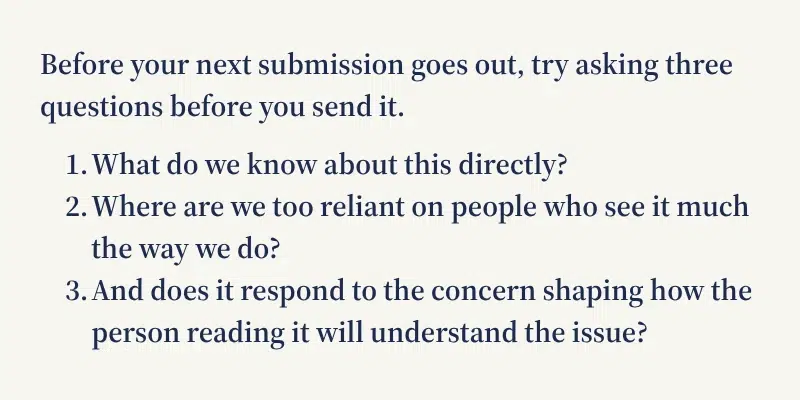
This is the conversation I have with boards and executive teams, about which reads their advocacy is built upon, and whether they’ll hold up when read by someone who has a different read of the situation.