

My kids missed the “all kids must learn to code” wave by about a year or two.
When they were in primary school it wasn’t part of the core program. Then it became a big deal. Coding clubs. Robotics. Messaging that it’s the essential literacy for the future. If your child couldn’t code, they’d be behind.
I remember those constant nagging thoughts: Have my kids missed the boat? What should I be doing to help them?
My kids are grown now, but I was reminded of that feeling while listening to the Galaxy Brain podcast episode about the AI Panic Cycle. Charlie Warzel and Anil Dash were talking about a viral X post by an AI executive, Matt Shumer.
The post had tens of millions of views in under a week, where Shumer wrote: “I am no longer needed for the actual technical work of my job.”
That is the part that stuck. Because coding, the skill that was meant to future-proof your kids, is one of the first skills being overtaken by the next wave of change.
It made me wonder what other strategic bets we’re making right now, as if the future has already been decided.
The strategic risk is not getting it wrong. It is betting like it cannot be wrong.
Most senior leaders I know do not want a “future of work” conversation. They want a strategy that keeps working while the ground moves.
This is where organisations trip themselves up in two predictable ways:
They go all-in on one future.
They restructure, invest, hire, and train as if the storyline is settled. If it is right, they look decisive. If it is wrong, they pay for years.
They do nothing because they cannot be sure.
They wait for certainty that never arrives, then end up reacting under pressure, with less choice and more risk.
The smarter move sits in the middle: prepare for multiple plausible futures without spreading yourself so thin that nothing lands.
One number worth taking seriously
The World Economic Forum puts a clean figure on how unstable “the right skills” really are:
“Overall, employers expect 39% of workers’ core skills to change by 2030.”
— World Economic Forum
That is a strategy warning not to put all your eggs in one basket.
If that level of change is even roughly true, then making single-point bets in your operating model, your workforce shape, or your tech stack gets expensive quickly.
Evergreen moves and perishable bets
Some strategy choices are evergreen. They make you stronger across multiple futures. They don’t tie you to one tool, one vendor, one way of working, or one neat forecast.
Some choices are perishable. They only pay off if the world turns out the way you hope. When conditions shift, they can turn into unrecoverable sunk cost, capabilities you don’t need, and fragile processes.
Coding was sold as evergreen. In hindsight, a lot of it was perishable. The evergreen part was underneath it: structured thinking, problem definition, verification, and judgement.
The point is not to “teach everyone the right thing”. It’s to invest in moves that keep options open and decision quality high, and surface the evergreen elements, while running contained bets on the futures you think are most likely.
That is what “prepare for multiple futures” looks like in practice.
The Evergreen or Perishable filter
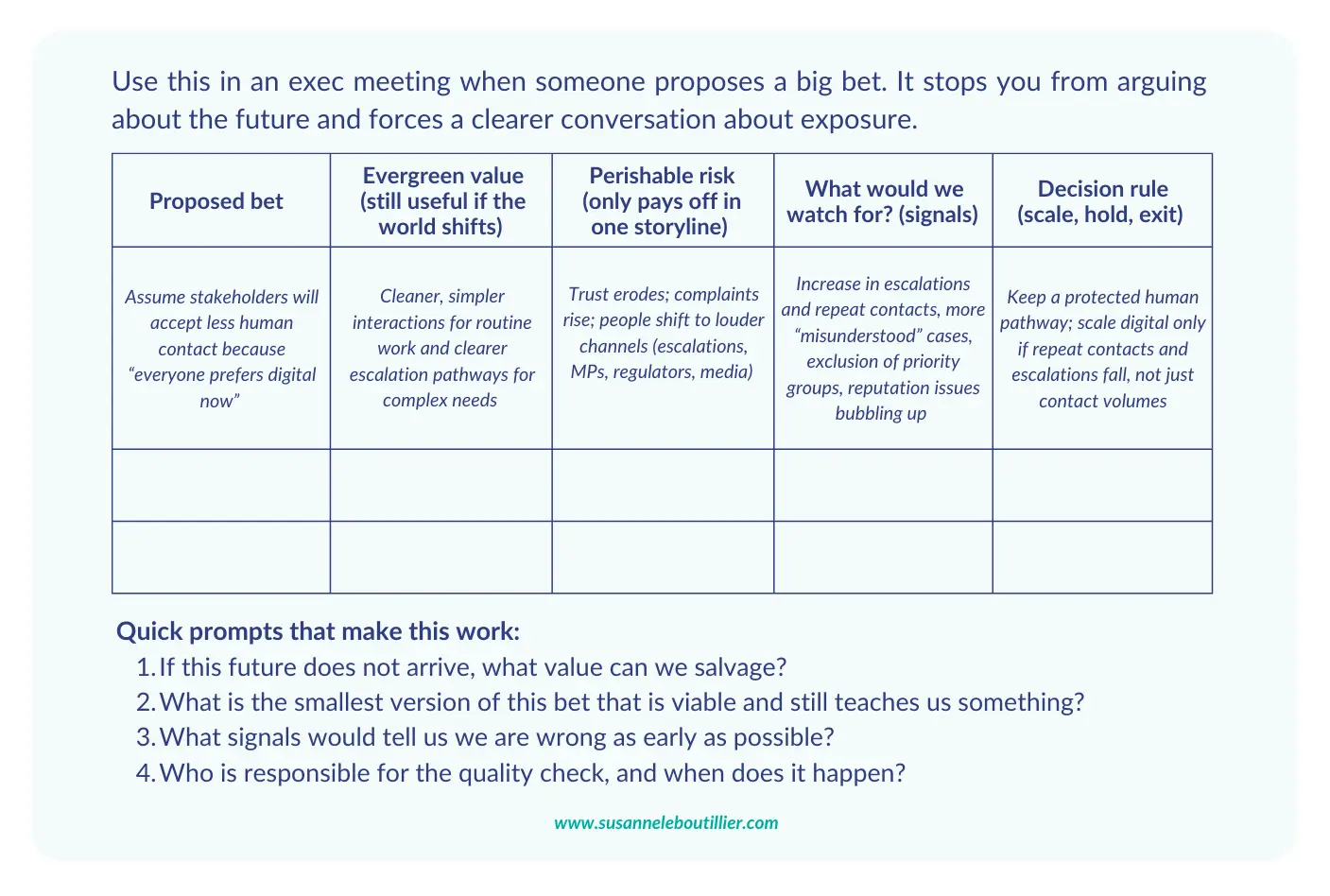
Screenshot it. Use it repeatedly. The value comes from the discipline, not the novelty.
Three questions for this week
-
Where are we acting as if one future is certain in our strategy, operating model, or investment plan?
-
Which current “must-have” initiative becomes a liability if the world turns out differently?
-
What are the evergreen moves we can double down on that improve decision quality and adaptability, no matter what happens next?