

When Survival Looks Like Success—Until It Doesn’t
I didn’t even realise I was crying.
I was sitting in a boardroom, surrounded by smiling colleagues, when someone quietly pointed out that tears were streaming down my face. I hadn’t noticed. I felt fine—or so I thought.
But I wasn’t fine.
What I didn’t know then was that I was deep in burnout. My body had started telling the truth long before I was willing to admit it. I thought I was holding it all together. In reality, I was stuck in survival mode—reacting, over-functioning, and too busy to notice I’d crossed the line between pressure and damage.
You might not be sitting in a boardroom with silent tears. But the patterns are often the same. The pressure to perform. The absence of pause. The slow drift away from what matters. It doesn’t always show up as burnout—it might look like relentless busyness, second-guessing every decision, or feeling disconnected from your team.
It wasn’t the urgency that undid me. It was everything underneath it.
The constant push to meet expectations. The belief that I had to keep it all together. The erosion of space to think, reflect, and feel.
The signs aren’t always loud. They show up quietly in the background: short tempers, lost perspective, difficulty making decisions, over-functioning—doing more while achieving less—or a creeping numbness to things you used to care about. In my case, it was also the physical signs—the tears that slipped past my awareness until someone else pointed them out.
When Complexity Hits, It’s the Centred Leaders Who Hold
This is why leadership needs to hold when everything shifts.
Not because we want to appear calm.
Not to tick a box for resilience.
But because you cannot lead well or have an impact from a place of chronic reaction.
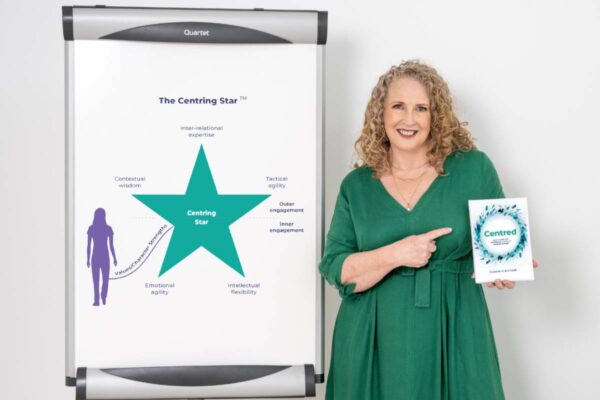
This is why I wrote Centred and developed the Centring Star—because I learned, through experience and research, that there is a better way to lead through the storm.
I’ve spent more than two decades working with leaders navigating everything from major restructures to system-wide reform. And what I know is this: technical skill isn’t what holds in complexity. It’s the ability to stay anchored, adaptive, and human under pressure.
However, Gallup’s 2024 Global Workplace Report revealed that only 21% of employees are engaged, with manager disengagement rising sharply. The cost? An estimated US $438 billion in lost productivity.
When leaders are stretched too thin, organisations feel it fast—through culture, outcomes, and strategic misalignment. What’s happening for the leader shapes everything around them.
Leadership that holds when everything shifts is like stepping into the eye of a cyclone—not to escape the storm, but to catch your breath, reset your bearings, and decide how to re-enter with purpose.

And that begins with presence.
Because if you’re not fully here, you can’t lead from here.
“Wherever you are, be there totally.”
— Eckhart Tolle
Clarity Begins with Noticing—Before You Choose What’s Next
So—where are you right now?
Not just physically, but emotionally, mentally, relationally.
What’s happening within you? What’s happening around you?
And how might one be shaping the other?
You don’t need to have it all figured out. But it helps to notice what’s true right now—before the next wave hits.
Pause and ask:
What’s really going on—for me, for this situation, for the people I lead?
And given what I now notice…
What becomes my next right step?
I work with leaders of complex change so they get results—without burning out or getting lost in the mess.
If that’s something you’re in the middle of right now, feel free to reach out.
No pitch—just a real conversation about what’s on your plate and what might help.