

When working with organisations, I often hear they’re challenged by the silos that exist between work areas and how hard it is to break them down.
Executive leaders express frustration at how hierarchical thinking means opportunities for peer collaboration are lost because the default is to escalate issues. Team members expect one executive to speak with another executive when the issue can be resolved at a lower level.
Or, worse, is when teams are so focused on their own goals and processes that they forget about the bigger picture and miss crucial opportunities to inform, connect or amplify related work.
People make unchallenged statements such as, “That’s not our problem”, ” That’s above my pay grade”, or “We’ve tried that before, and it didn’t work”.
Leaders feel like they are hitting a glass wall – where they can see the other side but can’t seem to reach it.
Would you like a useful key that can unlock windows into these silos and open peer-to-peer collaboration?
That key is questions. Not directives, orders, or mandates, but genuine, curious, open-ended questions that invite dialogue, spark curiosity, challenge assumptions, encourage connections, and inspire action.
Questions are more powerful than telling people to go and collaborate because they prompt action over obedience, respect the other person’s perspective and expertise and stimulate thinking and creativity. They also foster ownership and accountability and set the scene for new opportunities and solutions to be revealed.

For example:
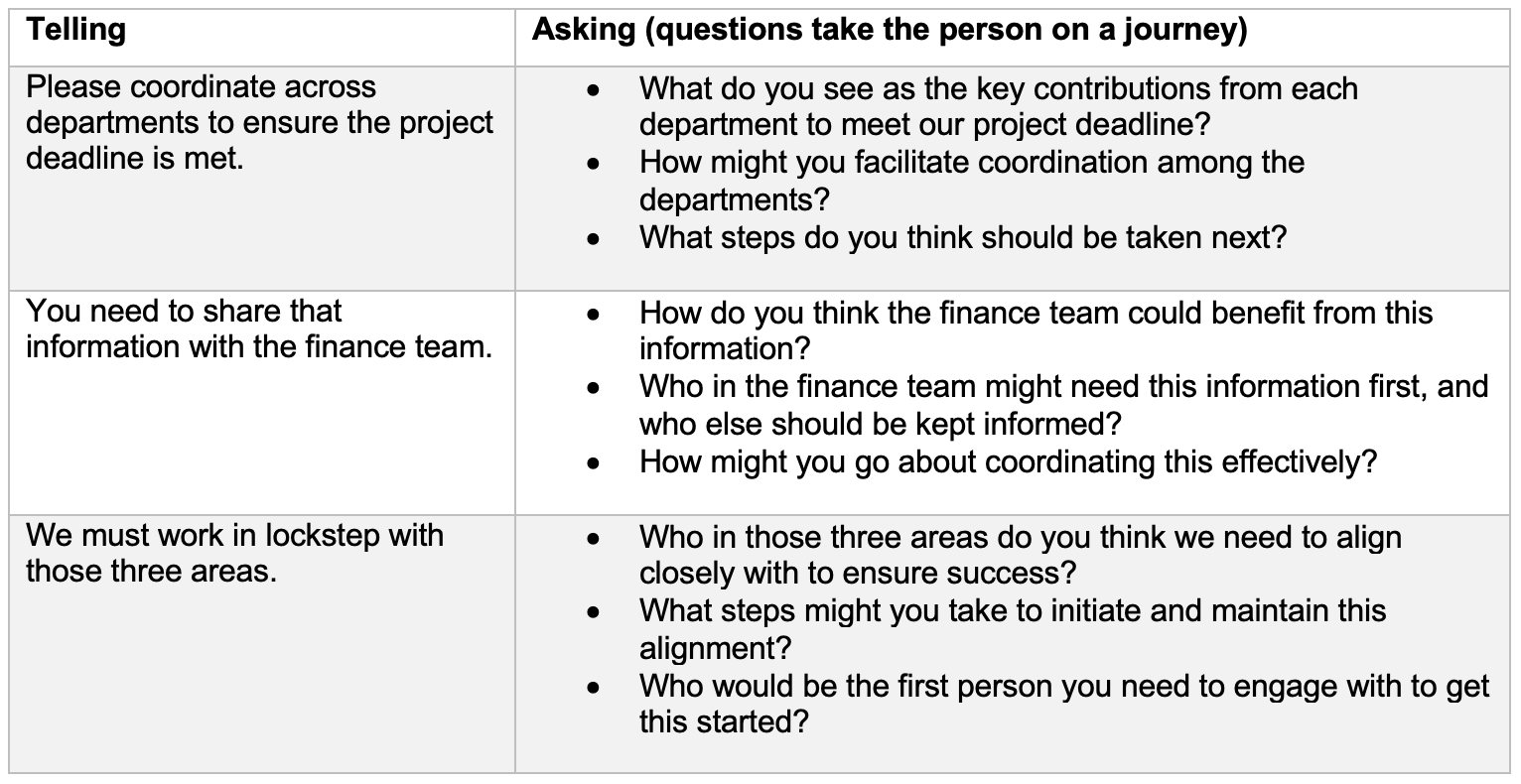
Can you see how asking questions changes the tone and outcome of the conversation and subtly indicates to the other person the expectation that they will take action instead of escalating it?
This approach is consistent with Edgar H. Schein’s work on “Humble Inquiry”. Schein defines Humble Inquiry as “the fine art of drawing someone out, of asking questions to which you do not know the answer, of building a relationship based on curiosity and interest in the other person.”
It’s not just a way of posing questions but a broader attitude that includes better listening, responding to what others are trying to tell us, and revealing relevant uncertainties and personal vulnerabilities.

If telling is like banging on the glass wall, asking is like opening a window. It lets in fresh air, light, and new perspectives and creates space for a change in how work gets done.
How can you humbly inquire more this week? You could start with one of these three challenges:
- Start your meetings with a question related to the topic or goal of the meeting. For example, “What are we trying to achieve today?” “What are the biggest challenges we face in this project?” or “What are we most curious about in this situation?”
- Reach out to someone from a different team or department. Ask them if they have a few minutes to chat. Then, ask them about their work, goals, challenges, insights, and ideas. Be genuinely interested and curious. Listen actively and ask follow-up questions. You might be surprised by what you learn and how you connect.
- Challenge yourself to ask more questions than you answer. Instead of giving advice, solutions, or feedback, ask questions that help the other person think for themselves, discover their own answers, and take ownership of their actions. For example, “What do you think is the best way to approach this?” or “How do you feel about the outcome?” or “What would you do differently next time?”
Questions don’t only get information. They can influence, motivate, and empower others.
How will you use them to break down silos and build bridges this week?