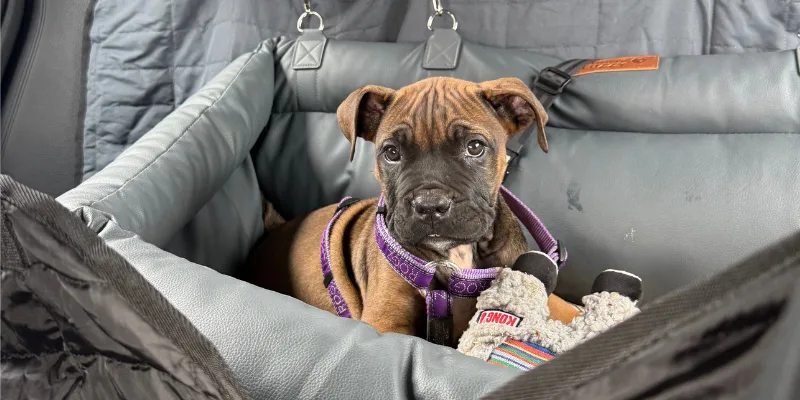
We picked up our new puppy Ripley, a Boerboel, from Kingaroy when she was eight weeks old.
On the drive back we needed a toilet stop, and Avo Fest was on in Blackbutt when we drove through. It seemed as good a time as any to get her out of the car.
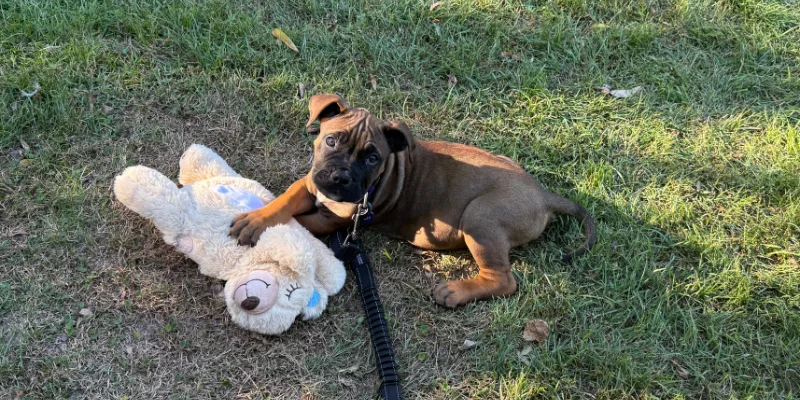
We carried her through the festival. A band playing loud rock covers was competing with Scottish pipers in full kit and there was a bloke sculpting a log with a chainsaw. Crowds of people, and the smells of many different foods assailed us. She was held the whole way, knew she was safe, and then she was back in the car and on her way home.
Ripley is the fifth dog we’ve welcomed into our home over more than twenty years. Most of the others came to us as rescues, already past the window where a dog works out what the world is and whether it can be trusted. Then there was Scully, who did come to us as a puppy, and missed much that the window offers anyway.
Our household at the time was arranged around another big dog who was hard to take anywhere uncontrolled. So, Scully mainly stayed at home on our acreage too. Nobody decided that and we found out what it cost years later.
Ripley is the first dog we have had inside the window and known enough to make best use of it.
Teams unknowingly get arranged around things like that too.
Protected for good reasons at the time
They are rarely kept from the pressure of their environment because someone decided to protect them. Instead, it happens for what look like valid reasons at the time.
The festival, for a team, is their operating environment. The stakeholder who asks the unscripted question. The board paper that comes back with more questions than it answered. The regulator, the media call, the number that will not add up. Being carried through it means meeting that environment with a leader alongside, in an amount the team can manage, before they have to meet it alone.
Your organisation is likely managing something that needs careful handling. It could be a stakeholder relationship the CEO looks after personally. A planned change in structure that is not talked about until all the pieces land. Or a leader who handles the difficult conversations herself because it is less work than managing the risk. None of that is a decision about the team’s capability. However, it means the team is held back from meeting the environment directly.
Then arrangements change. The CEO moves on, the restructure is announced without warning, and that difficult conversation arrives while the leader who usually handles it is on leave. And the team meets the whole festival at once, with nobody holding them.
Everything after that looks like a gap in people’s capability when it was a lack of preparation.
The opposite failure can come from throwing them in the deep end to see who swims. Ripley met the whole festival, but she met it carried. Dropped in the middle of Blackbutt on her own, she would have learned something very different about the world, and we would have spent years responding to the consequences.
What the research found
Associate Professor Peter O’Connor, and Professor Karen Becker studied attitudes to ambiguity in more than 800 Australian workers. Those with positive attitudes to ambiguity were more creative, better leaders and better performers, and reported lower stress.
The younger workers in the study wanted challenging work as much as the older ones did. They were also more likely to become anxious when uncertainty arrived, and less confident they could manage it. The researchers offer two possible reasons: overprotective parenting, and a daily life where technology has removed most of the small uncertainties people once had to work through. Both leave people with less practice.
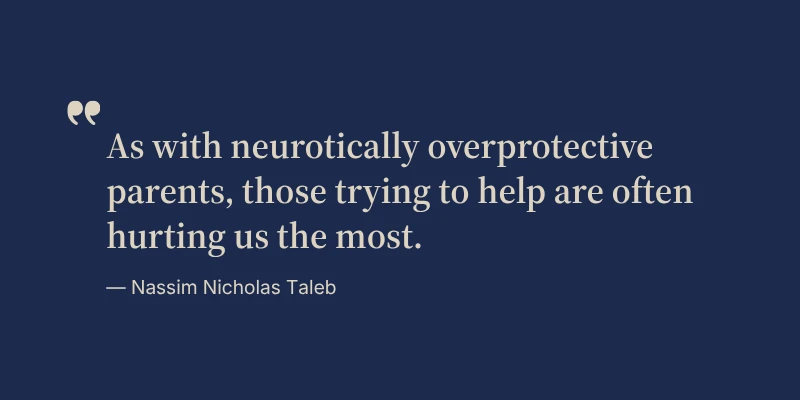
Nassim Nicholas Taleb, the former trader who wrote Antifragile, calls this the tragedy of modernity:
A team that is protected from every hard question is not stay ready for one.
A way to check
Can you name the last time your team met the environment with nothing between them and it? A briefing about the stakeholder does not count. Sitting across the table from the stakeholder and speaking in response to an unscripted question does.
If you cannot name it, you could be protecting them from valuable learning opportunities. You could start by looking at what you handle personally. Every question you answer on the team’s behalf is practice they did not get. If you are always the one across the table taking up all the available airtime, you are the only one getting the practice.
If they are being protected, consider the festival question. What is the small, safe dose you could give your team before the year ends?
One way to build the festival on purpose is a session where a team meets ambiguity, time pressure, complexity and uncertainty at the same time, with someone holding them through it, and where the consequences of getting it wrong stay recoverable. Ready Set… Wait! What? does that with the Ambiguity Apocalypse game. The game is competitive and teams have a surprising amount of fun with it. What they take back is the capacity to think, decide and speak up when nobody has the answer yet, which is what makes it work as an end-of-year session.
What will your team have to handle next year that you are still handling for them today? If something came to mind, reach out and tell me what it is, and I will tell you where I would start.
Written with AI assistance. The thinking and the final wording are mine.