

I recently ran a session for QUT’s Pathways to Politics program, with a group of women preparing to stand for office at every level of government.
They worked in pairs, one as the politician and one as the adviser, with a scenario built from the experience of three women who have held office and a pack of question cards on the table between them. The adviser asked, the politician answered, and any used cards were moved above the row.
When I walked into the breakout rooms, cards were stacked above the row. Advisers were only asking the next question, and you could see it on the politician’s face, their answers going deeper each time, past the surface response they would have given if nobody had been asking.
Afterwards, many people told me the thing that made the difference was having someone else pull the cards and ask, while they worked the problem.
Their advisers did not have a better answer. They didn’t share an answer at all, and that is what made the questions work.
I think of that as the adviser’s seat: someone at the table whose job it is to ask the question, and who has nothing riding on the answer.
Why the person deciding is the wrong person to ask
Before the first cut in any operating theatre, someone who is not the surgeon runs a set of questions out loud, and the surgeon answers them. Right patient. Right side. What are we expecting, and what could go wrong. Nothing starts until the questions are done. The surgeon is likely the most skilled person present, and those questions exist because the person holding the scalpel at the moment of the cut is the wrong person to be asking themselves if everything is good to go.
Executive meetings often run the other way round. Papers arrive with the recommendation on the front page. The conversation focuses on the recommendation. When questions are asked it can feel like a challenge to the colleague who wrote the paper, rather than a question about the situation, and the questions that go deeper don’t get asked because nobody’s been given that job.
That job is different from being a devil’s advocate. A devil’s advocate argues for another answer. The adviser in the session I ran didn’t offer an answer, only the next question, before the politician had settled on anything.
When that doesn’t happen, the cost shows up later. By the time the question that would have changed the decision gets asked, the budget may already be committed, the change announced, and the people needed to make it work asked to implement something they were never part of deciding. What looks like an implementation problem often started as a paper that went through without anyone whose job it was to ask.
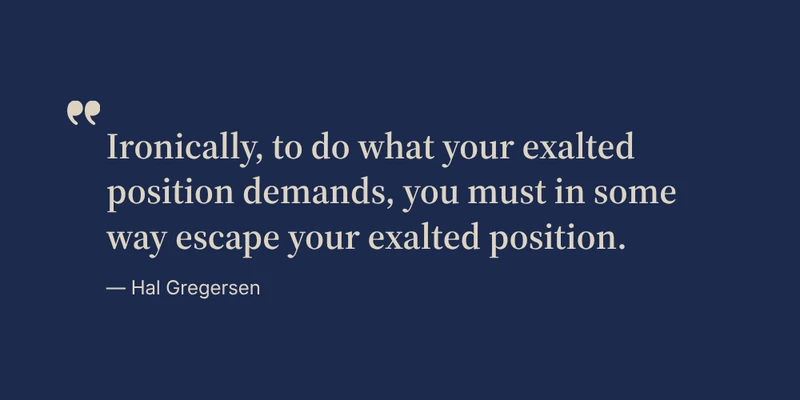
Hal Gregersen, then executive director of the MIT Leadership Center, drew on interviews with 200 executives for his 2017 Harvard Business Review article, “Bursting the CEO Bubble.” He said:
The questions in the session moved people from a decision about “what” to “how are we going to get there, and who do we need”. By the second round, the piles on the tables were cards about the people around them, the ones nobody in public life gets anywhere without.
The adviser’s seat
The point is a better decision before time, money and goodwill are committed, and it takes one change to the meeting. The next time a paper arrives with a recommendation, have one person take the adviser’s seat. Get them to ask these six questions, in this order, before anyone responds to the recommendation, and to avoid sharing a view of their own.
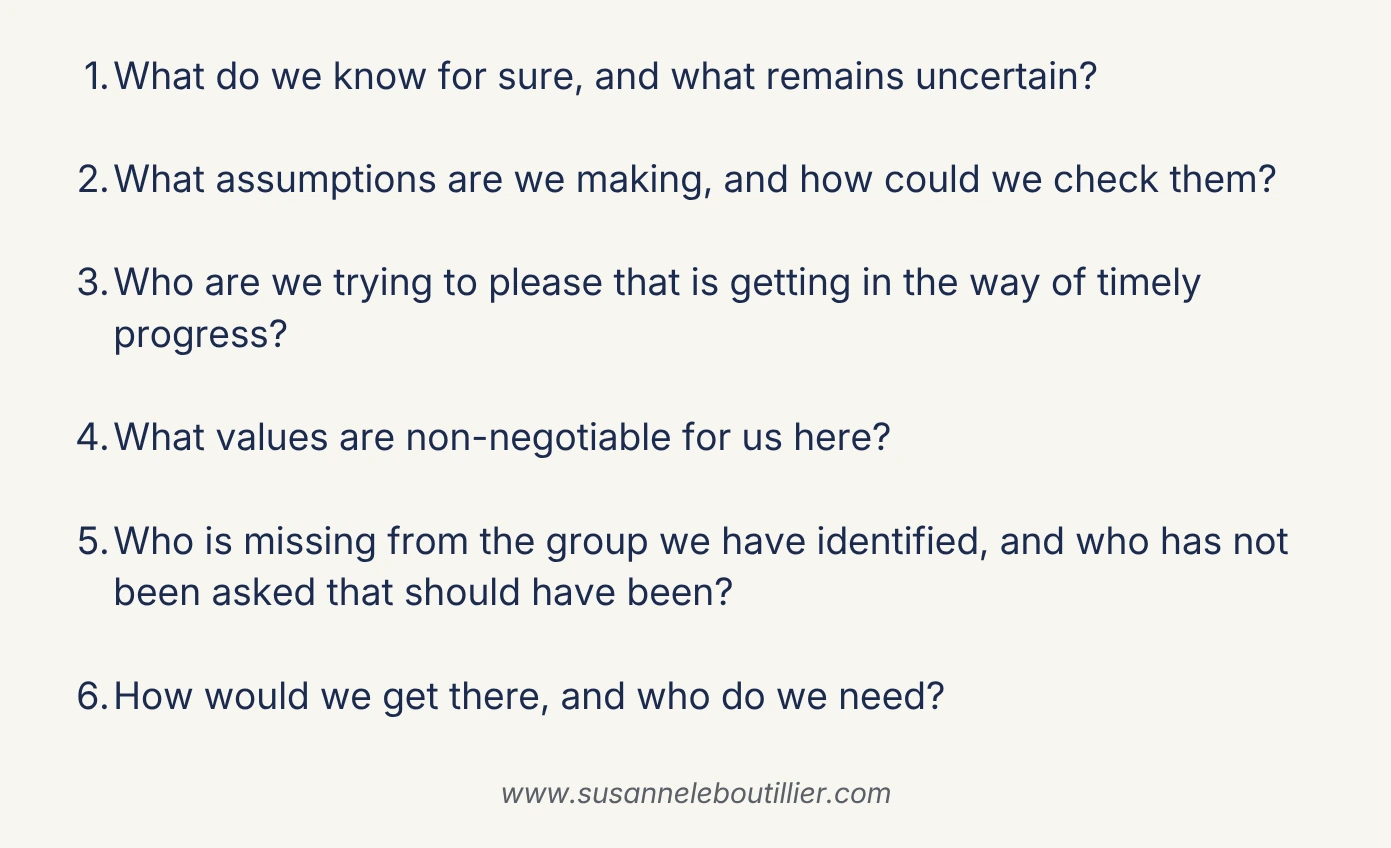
The order is the point. It walks the meeting from what you know, to what you are assuming, to what you are protecting, to who you need. That last move is the one many executive teams skip, and it is the one that can change your approach.
Three rules make it hold. The adviser offers no view. Nobody responds to the recommendation until the sixth question is on the table. And the CEO never takes the adviser seat, because the CEO is the one who has to make the final call.
Sessions like this are built so that situations are grounded in reality, and everyone leaves with new insights and a method they can keep using.
If your team needs a gameplan for making progress as everything keeps shifting, that is where I do this with leadership teams. If you think a session like this, tailored to your organisation’s challenges, would be useful, reach out and we can talk about what would best meet your needs.
Written with AI assistance. The thinking and the final wording are mine.