
Senior leaders across health and human service NGO providers, peak bodies and commissioners recently came together for the first Wider Lens session. Different organisations, different seats in the same system, sitting at one table under the Chatham House Rule.
Partway through the morning, one of them described a change they know they need, but were holding back progressing. Someone else said they are doing the same thing. By the time we had been around the room, it was clear many are slowing down required changes to protect their people.
They didn’t expect to question that call, and would not have, without the conversation we had in that room.
What made slowing down seem sensible
The pressure behind the decision to slow down change to protect staff is real and the level varies. Many of the people delivering services are already stretched well past what they are funded to do. One participant shared how, under a single contract, because of demand they delivered more than 50 per cent above what the contract required of them.
Add to that the structural challenges that come with award minimum wages rising 4.75 per cent on 1 July. Queensland’s indexation for non-government organisations came in at 3.31 per cent, calculated against a mid-year forecast of 2.75 per cent that has since been revised to 3.75.
And there are new cash flow challenges linked to the introduction of payday super from 1 July.
Many in that room are not currently having open conversations with their teams about what the reality of this pressure could look like over the next few years if changes are not made.
The instinct is to shield teams based on an assumption that senior leaders should carry the load because teams are already overwhelmed by increasing demand, complexity or needing to do more with less.
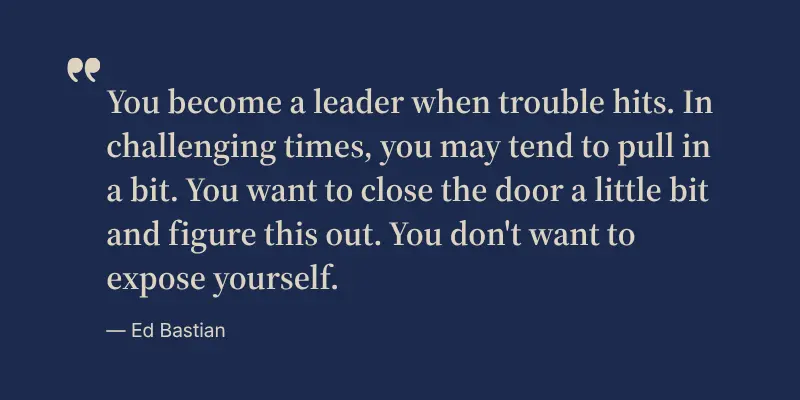
Ed Bastian, CEO of Delta, speaking to McKinsey’s Inside the Strategy Room podcast, described what leaders tend to do in situations like this.
What holding back does
The conversation confirmed senior leaders are pulling in, not to avoid exposure, but to avoid upsetting staff. In doing so, they have reduced the size of the brains trust in the organisation who can work out what is possible. They made a judgement about people’s capacity, on people’s behalf, from assumptions never tested.
Gartner reports that only 32 per cent of mid-to-senior leaders say their last change initiative achieved healthy adoption. Gartner defines that as acting on the change, on time, without adversely affecting performance and engagement or causing undue stress.
Undue stress is precisely what these leaders are trying to prevent. On Gartner’s numbers, most leaders do not get there, whatever their intent.
What going slow is for
Where the conversation went next was managing the pace of change, and what turns going slow from a mistake into a wise move.
Once you know where you need to land and by when, that early stretch of time changes character. It stops being a holding pattern and becomes the place you do the things that make speed possible later. Explaining what is happening and why the choices are being made. Bringing people into solving the parts they are closest to.
Work backwards from the landing point and you can see how much of that you can afford to do now and get clear on where you will need to pick up the pace of change, by when.
Without a landing point, going slow becomes a series of postponements that tend to end the same way. The deadline arrives, and people are asked to run towards something without understanding why because they were never brought along.
I learnt this early in my career. I worked in industrial relations in Queensland Health, at a time when we were operating on the smell of an oily rag. That was before the entirety of the health budget was doubled in a single State budget decision.
Because the constraints we had to operate under had been explained to us rather than absorbed somewhere above us, we started a user pays insights subscription service, and other parts of the health system valued that expertise enough to pay for it.
The constraint drove innovation. It only worked because the people on the inside knew what the constraint was, where they were heading and were invited to help bridge the gap.
Handed to people who are already past their limit, with no sense of where it ends, constraints do the opposite.
Why the rough landing point must be known
Boards and executive teams that understand the context and work backwards from rough scenarios now, will have more options before the pressure solidifies and lands at full weight.
Name the date at which your current cost base stops being affordable on current funding assumptions. An actual date. Then ask what must be true at different points in time before it. That is the landing point, and those points are the gates you need to get through. It also gives you the windows in which you can bring your people into the problem rather than presenting them with an answer that may not include the best available options. I work with boards and executive teams on exactly these calls.
Pace of change is where The Wider Lens conversation landed, and it is where the next Wider Lens will pick the conversation up. Each session builds on what the previous room surfaced, so this one goes further into pacing: how to work out where you need to land and by when, what to do with the time before you get there, and how to bring people into the problem.
Brisbane, next quarter. Two and a half hours at curated cross-sector tables, under the Chatham House Rule. I set the questions, push the thinking, bring in perspectives, then draw the threads together so you leave with something you can take back into your own organisation.
If you would like an invitation, register your interest here.